

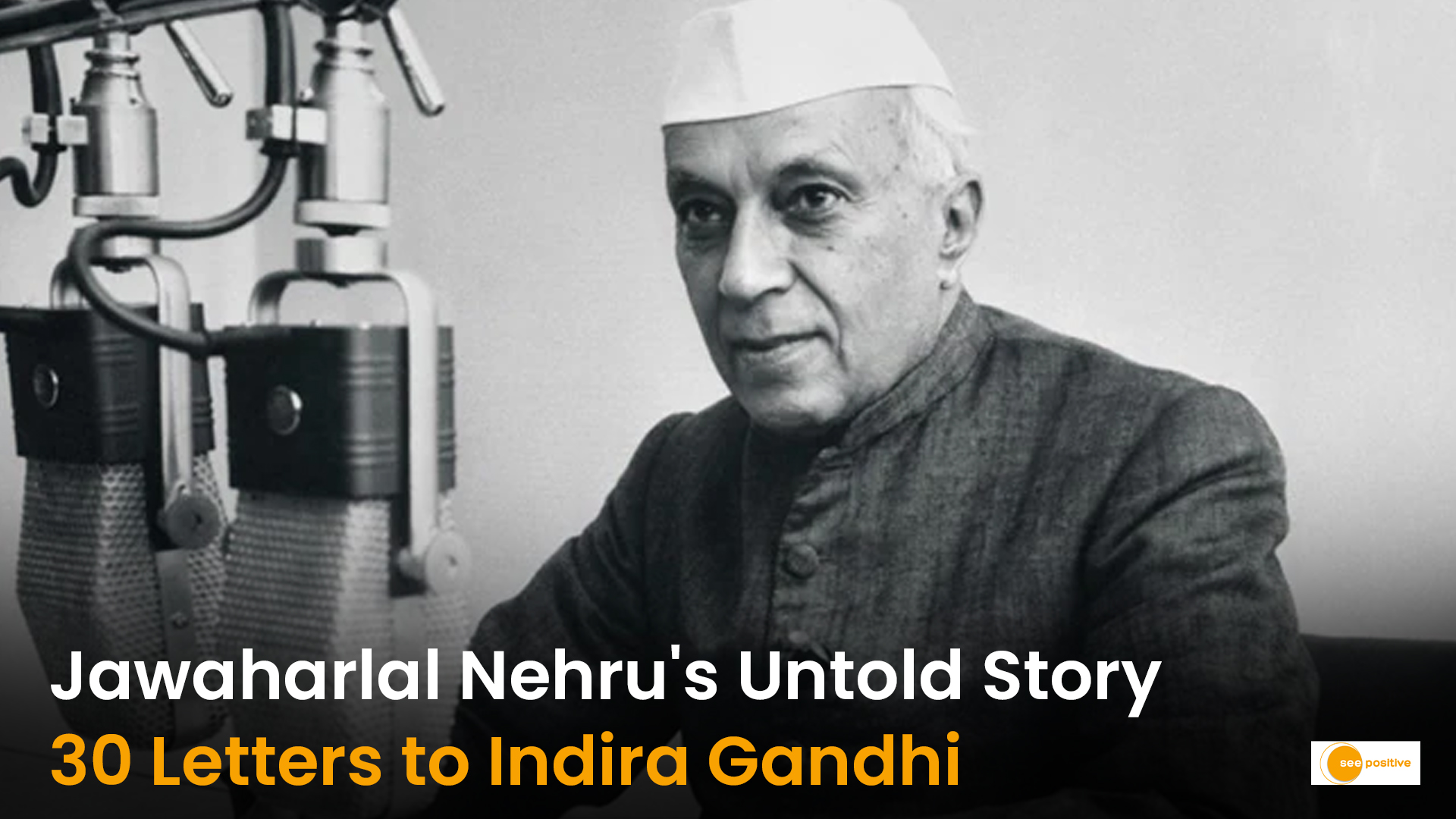
When we think of Jawaharlal Nehru, India’s first Prime Minister, we remember his role in the freedom struggle, his leadership, and his contribution to independent India. But there is another fascinating side of Nehru that many people may not know — his role as a father who used letters to introduce his young daughter to the history of the world.
In 1928, Nehru wrote a remarkable series of letters to his ten-year-old daughter, Indira Priyadarshini, who would later become India’s first woman Prime Minister. What began as a father’s attempt to educate his daughter from a distance eventually became a celebrated book, Letters from a Father to His Daughter.
But the most surprising part of this story is that Mahatma Gandhi himself appreciated these letters and suggested that they should be published.
Why Did Jawaharlal Nehru Write Letters to His Daughter?
In the summer of 1928, Indira was staying in Mussoorie while her father was in Allahabad, busy with political responsibilities.
Being away from his daughter, Nehru decided to communicate with her through letters. However, instead of writing ordinary family messages, he chose to teach her something extraordinary.
He wrote about the formation of the Earth, the beginning of life, the evolution of human beings, animals, ancient civilizations, and the development of human societies.
Nehru wanted Indira to understand the world through curiosity, observation, and historical thinking rather than simply memorising facts.
According to the official Nehru Portal, these letters were written when Indira was just ten years old.
The Interesting Connection Between Mahatma Gandhi and Nehru’s Letters
One of the most fascinating facts about this story is Mahatma Gandhi’s reaction.
On July 29, 1929, Gandhi wrote a letter to Jawaharlal Nehru praising his letters to Indira.
Gandhi described them as excellent and suggested that they should be published. He also expressed his wish that they should be published in Hindi alongside the original version.
This was not just a casual compliment. Gandhi appreciated the way Nehru had attempted to reach his daughter’s heart and develop her understanding.
This historical correspondence is preserved in the published records of Gandhi’s writings.
From Personal Letters to a Published Book
Nehru’s 1928 letters eventually became a book titled Letters from a Father to His Daughter.
The collection consists of 30 letters written to Indira during the summer of 1928. It was published in 1929 by Allahabad Law Journal Press.
The book explores topics such as:
- How the Earth was formed.
- How the first living organisms appeared.
- The development of human beings.
- The growth of ancient civilizations.
- The beginnings of language and writing.
- The evolution of human societies.
What makes this book special is its conversational style. Nehru explained complex historical ideas in a manner that a young reader could understand.
The Story Did Not End With 30 Letters
Here comes another fascinating chapter.
Nehru continued writing to Indira during his imprisonment under British rule.
On New Year’s Day, 1931, he began a much larger series of letters about world history. Indira was then thirteen years old.
Over approximately thirty months, Nehru wrote nearly 200 letters while imprisoned.
These letters covered an extraordinary range of subjects, including ancient Greece and Rome, China, West Asia, Ashoka, Genghis Khan, Gandhi, Lenin, revolutions, wars, democracies, and dictatorships.
What makes this achievement even more remarkable is that Nehru wrote much of this historical series in prison without access to a proper reference library.
The letters were later published as Glimpses of World History, a major work of historical writing.
Five Fascinating Facts About Nehru’s Letters
1. Indira was only ten years old.
Nehru began his first series of educational letters when his daughter was just ten.
2. The first collection had 30 letters.
These were written during the summer of 1928 while father and daughter were in different cities.
3. Gandhi personally recommended publication.
His letter dated July 29, 1929, praised Nehru’s writing and recommended publishing it in Hindi as well.
4. Nehru wrote nearly 200 more letters in prison.
Beginning on New Year’s Day, 1931, he started a much larger series introducing Indira to world history.
5. His historical writing covered the entire world.
From ancient civilizations to modern political movements, Nehru attempted to explain how different societies and historical events were connected.
What Can We Learn From This Extraordinary Story?
The story of Nehru’s letters is more than a historical anecdote. It offers an important lesson about education and parenting.
Nehru believed that children should be encouraged to ask questions, explore nature, understand history, and develop their own perspectives.
Instead of giving his daughter expensive gifts, he gave her something that would stay with her for a lifetime — knowledge.
His letters remind us that education is not limited to classrooms and textbooks. Sometimes, a simple conversation or a thoughtful letter can open the door to an entire world.
A lesser-known dimension
Jawaharlal Nehru’s letters to Indira Gandhi reveal a lesser-known dimension of India’s first Prime Minister.
Behind the political leader was a father who wanted his daughter to understand the world, its people, and its history.
What started as 30 letters in 1928 eventually grew into a remarkable literary legacy.
Perhaps the most beautiful part of this story is that a father’s personal letters became a source of knowledge for generations of readers.
Have you ever read Letters from a Father to His Daughter or Glimpses of World History? Share your thoughts in the comments.

