

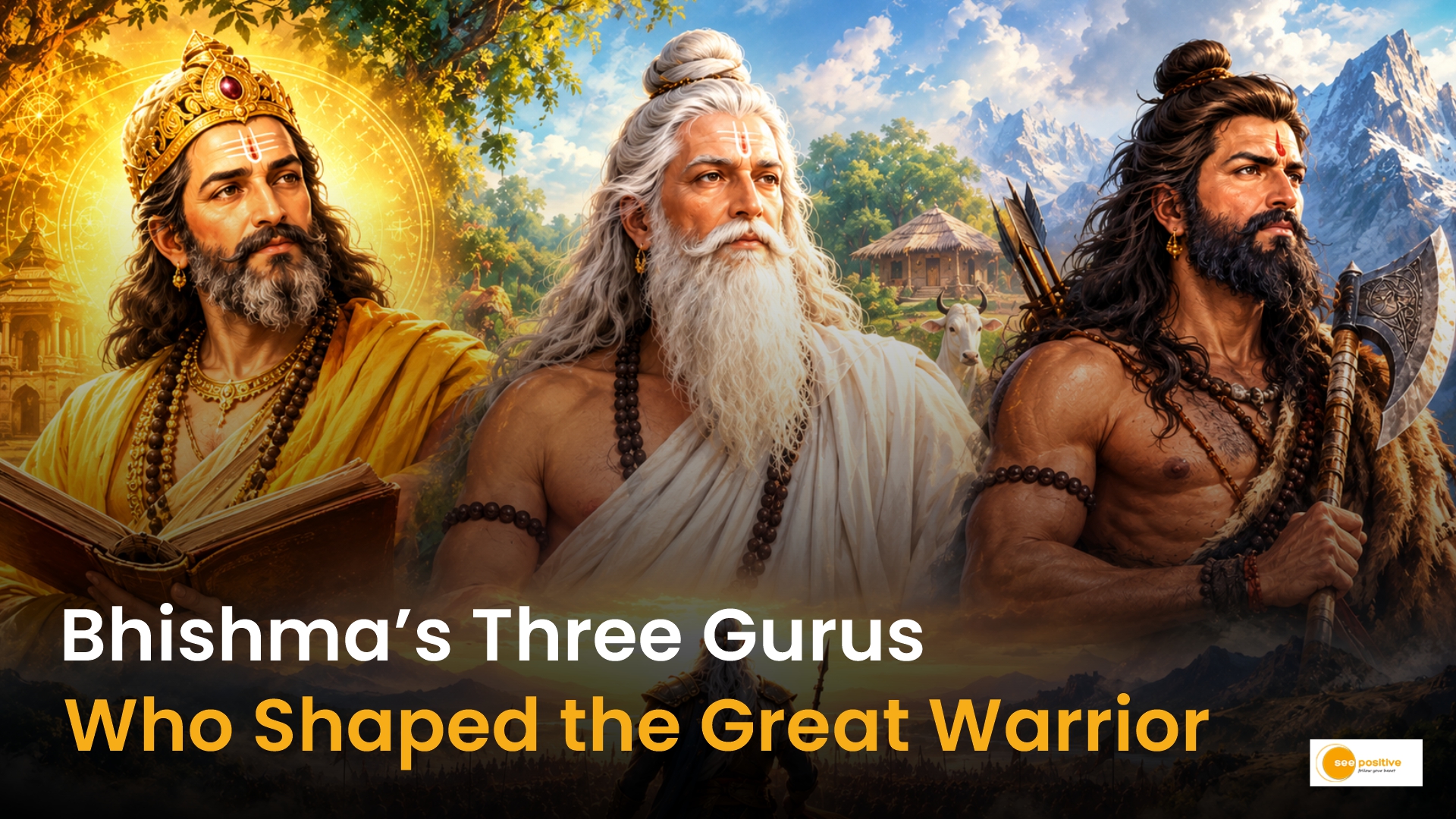
Bhishma is remembered as one of the greatest warriors, statesmen and spiritual figures in the Mahabharata. Born as Devavrata, the son of King Shantanu and Goddess Ganga, he became famous for his extraordinary courage, wisdom and his terrible vow of lifelong celibacy.
But behind Bhishma’s legendary abilities was an equally remarkable education. According to traditional accounts, Devavrata learned from several eminent teachers, with Brihaspati, Vashishtha and Parashurama standing out for their influence over his political wisdom, spiritual knowledge and martial abilities.
These teachers helped transform Devavrata into the extraordinary figure later known as Bhishma.
Who Was Bhishma Before He Became Bhishma?
Bhishma was originally named Devavrata. He was the eighth son of King Shantanu and Goddess Ganga and was also known as Gangaputra, meaning the son of Ganga.
From an early age, Devavrata was destined for greatness. He was trained in the knowledge expected of a future ruler and warrior and became highly accomplished in political science, sacred knowledge and warfare.
His life changed forever when King Shantanu wished to marry Satyavati.
Satyavati’s father wanted the children born from the marriage to inherit the throne of Hastinapura. Devavrata therefore gave up his claim to the kingdom. When Satyavati’s father remained concerned that Devavrata’s future children could someday challenge his descendants, Devavrata made an even greater sacrifice: he took a lifelong vow of celibacy.
This extraordinary oath became known as the Bhishma Pratigna, or the terrible/fearsome vow. From that moment, Devavrata became known as Bhishma. His father also granted him the boon of choosing the time of his death.
1. Brihaspati – The Teacher of Politics and Statecraft
One of Bhishma’s important teachers was Brihaspati, traditionally regarded as the preceptor of the Devas.
Brihaspati is associated with wisdom, political knowledge and the principles of governance. According to the traditional account, he taught Devavrata the duties of kings, political science and statecraft.
This education became extremely important during Bhishma’s later life.
Bhishma was not merely a battlefield warrior. He was also an experienced statesman who understood the responsibilities of a king and the complexities of running a kingdom.
His knowledge allowed him to advise generations of Kuru rulers. Even after the devastating Kurukshetra War, Bhishma became an important source of political and ethical wisdom for Yudhishthira.
While lying on his bed of arrows, Bhishma gave Yudhishthira extensive teachings on kingship, governance, duty and dharma.
His political education under teachers such as Brihaspati helped establish the foundation for this extraordinary wisdom.
2. Vashishtha – The Teacher of Sacred Knowledge and Dharma
The second great teacher associated with Devavrata’s education was Sage Vashishtha, one of the most revered sages in Hindu tradition.
According to traditional accounts, Vashishtha taught Devavrata the Vedas, Vedangas and sacred knowledge.
This education was different from the martial training he later received from Parashurama.
Vashishtha’s teachings helped develop the intellectual and spiritual side of Devavrata. Bhishma’s later identity was therefore not limited to that of a warrior. He was also deeply knowledgeable about dharma, religious principles, duties and righteous conduct.
This combination of spiritual knowledge and political understanding made Bhishma one of the most respected elders of the Kuru dynasty.
His life demonstrates that, in the traditional ideal of kingship, strength alone was not enough. A great ruler was expected to understand dharma, wisdom, duty and responsibility.
3. Parashurama – The Guru Who Trained the Warrior
Perhaps the most famous of Bhishma’s teachers was Lord Parashurama, the warrior-sage and son of Jamadagni.
Parashurama trained Devavrata in warfare and martial skills. This training contributed to Bhishma’s reputation as one of the most formidable warriors of his age.
The relationship between Bhishma and Parashurama later became one of the most dramatic episodes in the Mahabharata.
Bhishma vs Parashurama
Years later, the two would face each other in battle.
The conflict began with Amba, one of the princesses of Kashi. Bhishma had carried away Amba and her sisters for his half-brother Vichitravirya. Amba, however, wished to marry King Shalva. After a series of events, she sought Parashurama’s help against Bhishma.
Parashurama ordered Bhishma to marry Amba. Bhishma refused because doing so would violate the vow of celibacy he had taken.
The disagreement eventually led to a legendary confrontation between teacher and student.
According to the traditional account, Bhishma and Parashurama fought for 23 days, yet neither was able to defeat the other decisively.
The episode reveals just how extraordinary Bhishma’s training had been.
He respected Parashurama as his guru, but he also refused to abandon the vow that had defined his entire life.
More Than Three Teachers
Although the popular story often highlights three principal gurus, the traditional account of Devavrata’s education is more extensive.
One traditional compilation lists Brihaspati, Shukracharya, Vashishtha, Chyavana, Sanatkumara, Markandeya, Parashurama and Indra among the teachers or sources of knowledge associated with his education.
This is an important distinction.
- Brihaspati – political science and the duties of kings
- Vashishtha – Vedic and sacred knowledge
- Parashurama – warfare and martial discipline
Together, these traditions portray Devavrata as a man educated in the three dimensions necessary for an ideal warrior-statesman: wisdom, governance and military power.
How His Education Shaped Bhishma
Bhishma’s greatness came from more than physical strength.
His education gave him the ability to fight like a warrior, think like a statesman and speak like a teacher.
His political knowledge allowed him to advise the Kuru rulers. His knowledge of sacred traditions gave him a deep understanding of dharma. His martial training made him one of the most formidable fighters on the battlefield.
Yet his life also reveals a tragic paradox.
Bhishma was powerful enough to influence the fate of the Kuru kingdom, but his own vow became a source of both greatness and suffering.
His decision to renounce the throne and marriage protected his father’s happiness, but it also changed the succession of the Kuru dynasty and influenced events that eventually led to the Kurukshetra War.
The Greatest Lesson From Bhishma’s Gurus
The story of Bhishma’s education contains a deeper lesson.
A person’s greatness is not created by one skill alone.
Brihaspati represents wisdom and governance.
Vashishtha represents spiritual knowledge and dharma.
Parashurama represents strength, discipline and martial excellence.
Bhishma combined these dimensions into a single extraordinary personality.
Yet the Mahabharata also reminds us that knowledge and power do not always guarantee a perfect outcome. Bhishma himself faced painful moral dilemmas throughout his life and was unable to prevent the destruction of the Kuru dynasty.
That is what makes his story so compelling.
He was not simply an invincible warrior. He was a complex human being caught between personal vows, family loyalty, political duty and dharma.
Why Bhishma Is Still Remembered
Bhishma’s influence continued even after the Kurukshetra battlefield had fallen silent.
Lying on his bed of arrows, he shared his knowledge with Yudhishthira. He discussed kingship, duty, morality and righteous conduct, transforming his final moments into a profound lesson in leadership and dharma.
His story continues to fascinate readers because it combines extraordinary strength with extraordinary sacrifice.
Devavrata became Bhishma because of a vow.
But Bhishma became immortal in cultural memory because of the life he lived after taking that vow.
Most unforgettable figures of the Mahabharata
The story of Bhishma’s gurus reveals that the legendary warrior of the Mahabharata was shaped by an extraordinary education.
Brihaspati gave him knowledge of politics and kingship. Vashishtha guided him in sacred learning and dharma. Parashurama trained him in the art of warfare.
Although traditional accounts mention several other teachers as well, these three provide a powerful way to understand the major pillars of Bhishma’s education.
His life ultimately shows that true greatness requires more than strength. It requires knowledge, discipline, sacrifice and the courage to remain committed to one’s principles—even when the consequences are painful.
That is why Bhishma, the son of Ganga and the great elder of the Kuru dynasty, remains one of the most unforgettable figures of the Mahabharata.

