

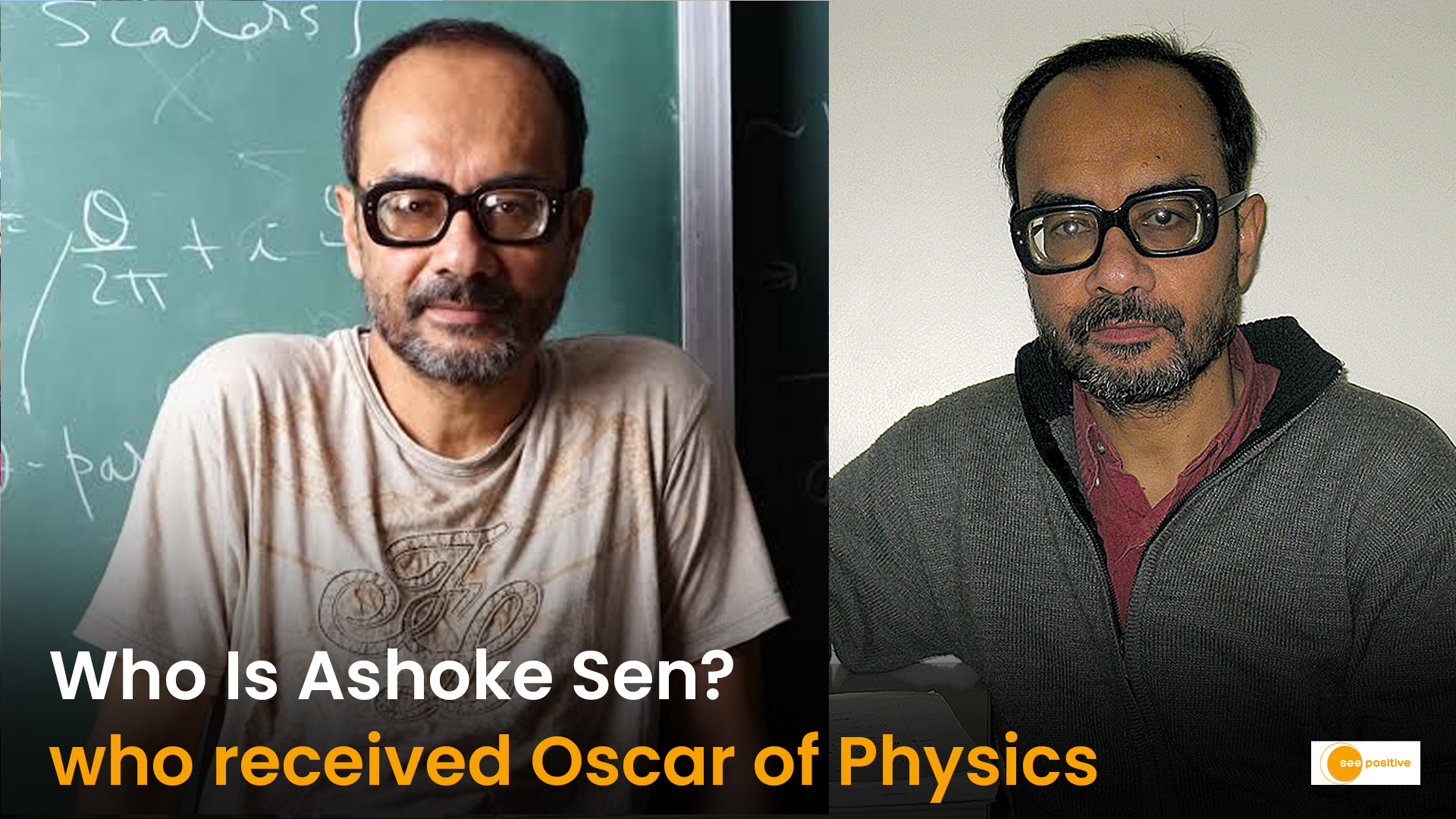
India has another reason to celebrate its scientific achievements. Renowned Indian theoretical physicist Professor Ashoke Sen has become the first Indian scientist to receive the prestigious 2026 Oskar Klein Medal, an international honour recognising outstanding contributions to theoretical physics.
Often described as the ‘Oscar of Physics’, the Oskar Klein Medal is associated with some of the world’s most distinguished physicists, including Stephen Hawking, Peter Higgs and Steven Weinberg.
But who exactly is Ashoke Sen? What has he contributed to science? And why is his research on string theory, black holes and gravity considered so important? Let’s explore his life, education, career and major achievements.
Who Is Ashoke Sen?
Professor Ashoke Sen is one of India’s most respected theoretical physicists, internationally recognised for his groundbreaking contributions to string theory and quantum gravity.
- Full Name: Ashoke Sen
- Date of Birth: July 15, 1956
- Birthplace: Kolkata, West Bengal
- Profession: Theoretical Physicist
- Specialisation: String Theory, Quantum Gravity and Black Hole Physics
- Major Recognition: 2026 Oskar Klein Medal
Ashoke Sen’s research has helped scientists understand the relationship between different string theories, the behaviour of black holes and the connection between quantum mechanics and gravity.
He has also received several prestigious honours, including the 2012 Breakthrough Prize in Fundamental Physics, the Dirac Medal in 2014 and India’s Padma Bhushan in 2013.
What Is the Oskar Klein Medal? Why Is It Called the Oscar of Physics?
The Oskar Klein Medal is an internationally recognised award established in 1988. It is named after Swedish theoretical physicist Oskar Klein.
The medal is awarded annually by Stockholm University and the Nobel Committee for Physics of the Royal Swedish Academy of Sciences to recognise outstanding contributions to physics.
Previous recipients include:
- Stephen Hawking
- Peter Higgs
- Steven Weinberg
- Hans Bethe
- Chen-Ning Yang
Ashoke Sen’s selection for the 2026 medal makes him the first Indian physicist to receive this honour.
He also delivered the 2026 Oskar Klein Memorial Lecture, titled ‘Gravity from Strings and Strings from Gravity’, at Stockholm University’s AlbaNova Centre on October 22, 2026.
Important: The Oskar Klein Medal is not the Nobel Prize in Physics. The phrase ‘Oscar of Physics’ is an informal description of its prestige and is not its official name.
Ashoke Sen’s Educational Background: From Kolkata to Global Recognition
Ashoke Sen’s journey in science began in Kolkata, West Bengal. His academic journey reflects his dedication to mathematics and theoretical physics.
- Schooling: Shailendra Sircar Vidyalaya, Kolkata.
- Graduation: Presidency College, Kolkata, where he completed his BSc in 1975.
- Postgraduate Studies: IIT Kanpur, where he completed his master’s degree in 1978.
- PhD: State University of New York at Stony Brook, USA, completed in 1982.
After completing his doctorate, Sen worked as a postdoctoral researcher at two prominent American research institutions:
- Fermilab (1982–1985).
- Stanford Linear Accelerator Center (1985–1988).
He subsequently returned to India and joined the Tata Institute of Fundamental Research (TIFR), Mumbai, in 1988.
He later spent many years at the Harish-Chandra Research Institute in Prayagraj, contributing to India’s theoretical physics research ecosystem.
What Has Ashoke Sen Discovered? Understanding His Major Contributions to Physics
Ashoke Sen’s research focuses on some of the most complex questions in modern physics. His contributions can be understood through three important areas.
1. String Theory: Understanding the Fundamental Building Blocks of the Universe
String theory is one of the most fascinating ideas in modern theoretical physics.
Traditional physics describes fundamental particles such as electrons and quarks as point-like objects. String theory proposes that these fundamental building blocks may instead be incredibly tiny vibrating strings.
Different vibrations of these strings could correspond to different particles.
Ashoke Sen made important contributions to understanding how different versions of string theory are connected. His work helped scientists move closer to the possibility of a unified theoretical framework for the fundamental forces of nature.
2. S-Duality: Connecting Strong and Weak Forces
One of Ashoke Sen’s most influential contributions is his research on a concept called S-duality.
In simple terms, S-duality suggests that certain physical theories describing strong interactions can be mathematically equivalent to other theories describing weak interactions.
Why is this important?
- Some physical problems are extremely difficult to solve when interactions are strong.
- A mathematically equivalent theory with weak interactions can make those problems easier to investigate.
- This relationship helps physicists understand connections between apparently different theories.
Sen’s research on strong-weak duality played an important role in establishing connections between different string theories.
This work was a major reason behind his 2012 Breakthrough Prize in Fundamental Physics.
3. Black Holes: Understanding Their Mysterious Nature
Black holes are among the most mysterious objects in the universe. Their gravitational pull is so powerful that even light cannot escape once it crosses the event horizon.
One major scientific question is how to understand the entropy of a black hole.
Entropy is a measure of the number of possible microscopic arrangements of a physical system.
Ashoke Sen developed mathematical methods, including the entropy function formalism, to help calculate the microscopic states of certain black holes.
His research helped scientists connect black-hole entropy with the microscopic descriptions provided by string theory.
This is important because it helps physicists investigate the relationship between gravity, quantum mechanics and the fundamental structure of the universe.
Ashoke Sen’s Major Awards and Achievements
Ashoke Sen’s scientific career has been recognised through several prestigious national and international honours.
| Year | Award or Recognition |
|---|---|
| 1989 | ICTP Prize |
| 1994 | Shanti Swarup Bhatnagar Prize |
| 1998 | Fellow of the Royal Society |
| 2001 | Padma Shri |
| 2009 | Infosys Prize in Mathematical Sciences |
| 2012 | Breakthrough Prize in Fundamental Physics |
| 2013 | Padma Bhushan |
| 2014 | Dirac Medal |
| 2026 | Oskar Klein Medal |
These awards reflect his extraordinary contributions to theoretical physics and his influence on international scientific research.
What Is the Breakthrough Prize in Fundamental Physics That Ashoke Sen Won in 2012?
Before receiving the Oskar Klein Medal, Ashoke Sen had already earned global recognition for his contributions to string theory.
In 2012, he received the Breakthrough Prize in Fundamental Physics for uncovering important evidence of strong-weak duality in certain supersymmetric string theories and gauge theories.
His research helped establish that different string theories, previously considered separate frameworks, could actually represent different limits of an underlying unified theory.
This was an important development in theoretical physics because it provided a new way of understanding the mathematical structure of the universe.
Why Is Ashoke Sen’s Achievement Important for India?
Ashoke Sen’s international recognition highlights India’s contribution to advanced scientific research.
His achievement is significant for several reasons:
- Global Recognition: He has brought international attention to Indian theoretical physics.
- Research Excellence: His work demonstrates India’s capabilities in advanced mathematical and theoretical research.
- Inspiration for Students: His journey can encourage young Indians to pursue careers in science and research.
- Indian Institutions: His career reflects the importance of institutions such as TIFR, ICTS and the Harish-Chandra Research Institute.
- Scientific Impact: His research has contributed to some of the biggest unanswered questions about gravity, black holes and the universe.
An especially interesting aspect of his career is that he returned to India after completing his postdoctoral research in the United States and continued his scientific work here.

