

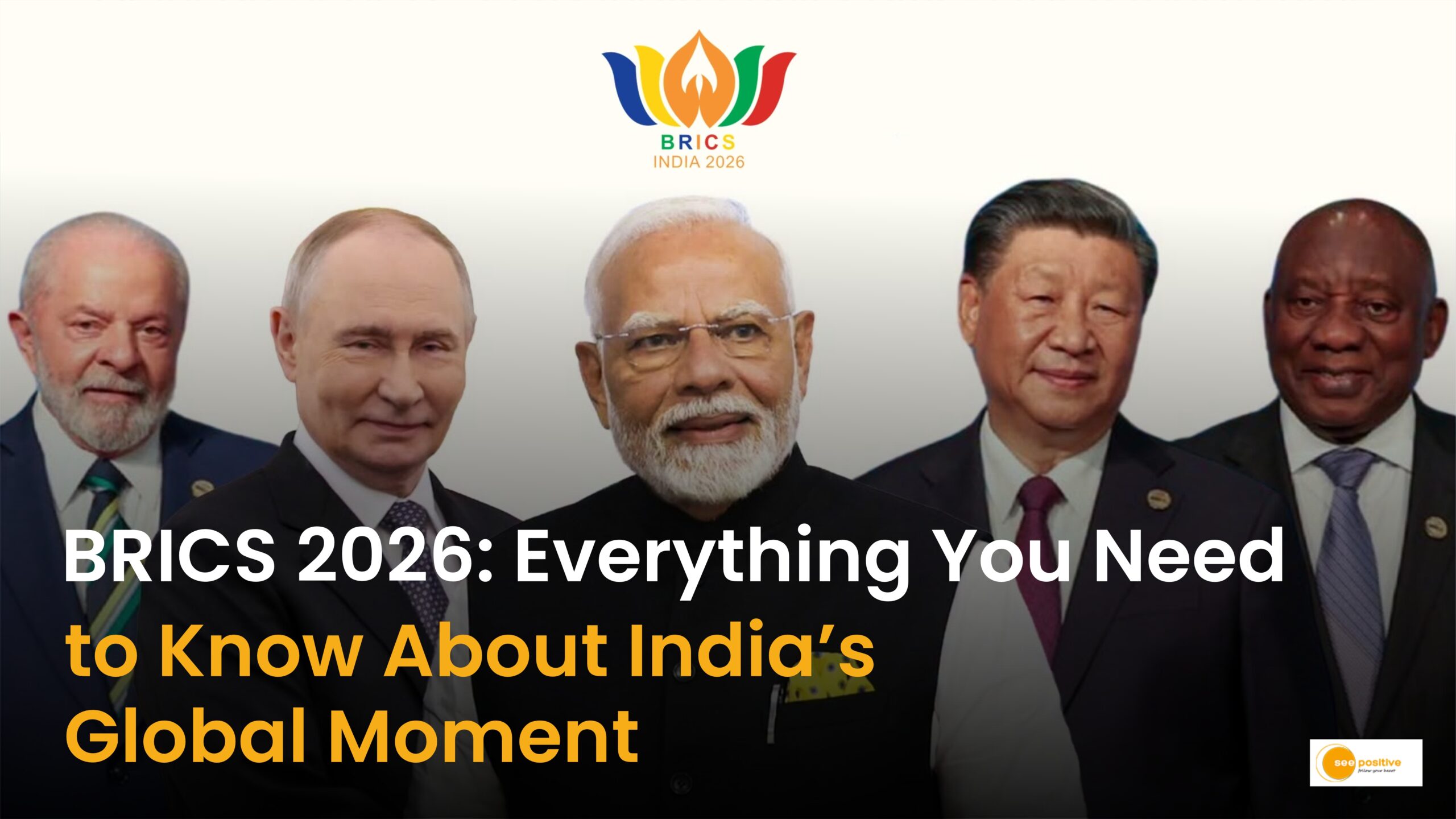
BRICS 2026 has placed India at the centre of one of the world’s most prominent groupings of emerging economies. India is holding the BRICS Chairship in 2026, with a focus on resilience, innovation, cooperation and sustainability.
But what exactly is BRICS? What does the name mean? Which countries are members? What does India’s 2026 Chairship focus on? And what is the significance of the BRICS logo?
Here is a fact-based guide.
What Is BRICS?
BRICS is a grouping that brings together major emerging economies and provides a platform for cooperation on economic, political, social and development-related issues.
The acronym originally stood for Brazil, Russia, India, China and South Africa.
The grouping has expanded considerably since its original formation. Its current membership includes countries from several regions, giving BRICS a broader representation across the Global South.
BRICS is not a military alliance. It is primarily a platform for cooperation and coordination among its participating countries.
BRICS 2026: Why India Is Important This Year
India is holding the BRICS Chairship in 2026.
According to the latest MyGov information released jointly with the Ministry of External Affairs, India’s chairship is guided by the theme:
“Building for Resilience, Innovation, Cooperation and Sustainability.”
The 2026 approach is described as people-centric and based on the principle of “Humanity First.”
This means India’s BRICS agenda is not being presented only through the lens of economics. The official 2026 outreach also places emphasis on technology, innovation, sustainable development, youth participation, culture and people-to-people connections.
What Are India’s BRICS 2026 Priorities?
The latest MyGov- and MEA-backed BRICS 2026 communication identifies several areas that citizens are being encouraged to understand and explore.
1. Resilience
Resilience is one of the four words in India’s official 2026 theme.
It reflects the broader objective of strengthening the ability of countries and societies to respond to global challenges while continuing their development journey.
2. Innovation and Technology
Technology and innovation are important components of India’s BRICS 2026 focus.
The official MyGov campaign specifically encourages citizens to highlight technology and innovation while presenting India’s role in BRICS.
3. Cooperation
Cooperation remains central to the BRICS framework.
India’s 2026 outreach encourages greater awareness of cooperation among BRICS countries and India’s role in strengthening such engagement.
4. Sustainable Development
Sustainable development is another major priority identified in the 2026 BRICS communication.
The focus connects development with long-term environmental, economic and social sustainability.
5. People-Centric Development
India’s 2026 Chairship is explicitly described as people-centric.
The government’s MyGov campaign also links this approach with the idea of “Humanity First.”
6. Youth Participation
Youth are another important part of India’s BRICS 2026 outreach.
The government is encouraging young citizens to engage with BRICS and communicate India’s role in the grouping through creative and informative content.
7. Culture and People-to-People Connections
BRICS cooperation is not limited to government-to-government relations.
The 2026 campaign specifically identifies culture and people-to-people connect as an area of focus.
What Does the BRICS Logo Mean?
An important point about BRICS branding is that there is not necessarily one permanent visual identity used unchanged for every year.
The country holding the BRICS Chairship can develop a visual identity reflecting its own cultural and national context.
For this reason, the meaning of a BRICS logo should always be considered in relation to the particular year’s presidency.
For India in 2026, the visual identity is connected with India’s broader BRICS Chairship messaging and its emphasis on cooperation, inclusiveness and people-centric development.
Rather than viewing the logo simply as a decorative symbol, it can be understood as part of India’s communication of its BRICS priorities.
How Did BRICS Begin?
BRICS has its roots in the term BRIC, which referred to Brazil, Russia, India and China.
The four countries held their first formal leaders’ summit in 2009. South Africa subsequently joined the grouping, giving it its present “BRICS” name.
Over time, BRICS developed beyond its original economic focus and became a broader platform for cooperation on international and development-related issues.
mportant to distinguish between its original five members and the expanded membership.
Interesting BRICS Facts and Trivia
BRICS Was Not Originally the Name of a Group
The word BRIC began as an economic term before becoming associated with a formal leaders’ grouping.
The addition of South Africa changed the acronym to BRICS.
The Letter “S” Has a Specific Meaning
The “S” in BRICS represents South Africa.
It was added after South Africa joined the original BRIC grouping.
India Is Chairing BRICS in 2026
One of the most important current facts is that India holds the BRICS Chairship in 2026.
The latest MyGov campaign specifically calls on citizens to showcase India’s role and the significance of its 2026 Chairship. M
“Humanity First” Is Part of India’s 2026 Approach
India’s 2026 BRICS Chairship is described by MyGov as having a people-centric and “Humanity First” approach.
Why BRICS 2026 Matters for India
India’s BRICS 2026 Chairship provides an opportunity to shape discussions among a diverse group of emerging and developing economies.
The official 2026 messaging places considerable emphasis on innovation, technology, sustainable development and people-centric cooperation.
It also seeks to bring BRICS beyond diplomatic meetings and into public awareness by encouraging citizens and young people to understand India’s role in the grouping

