

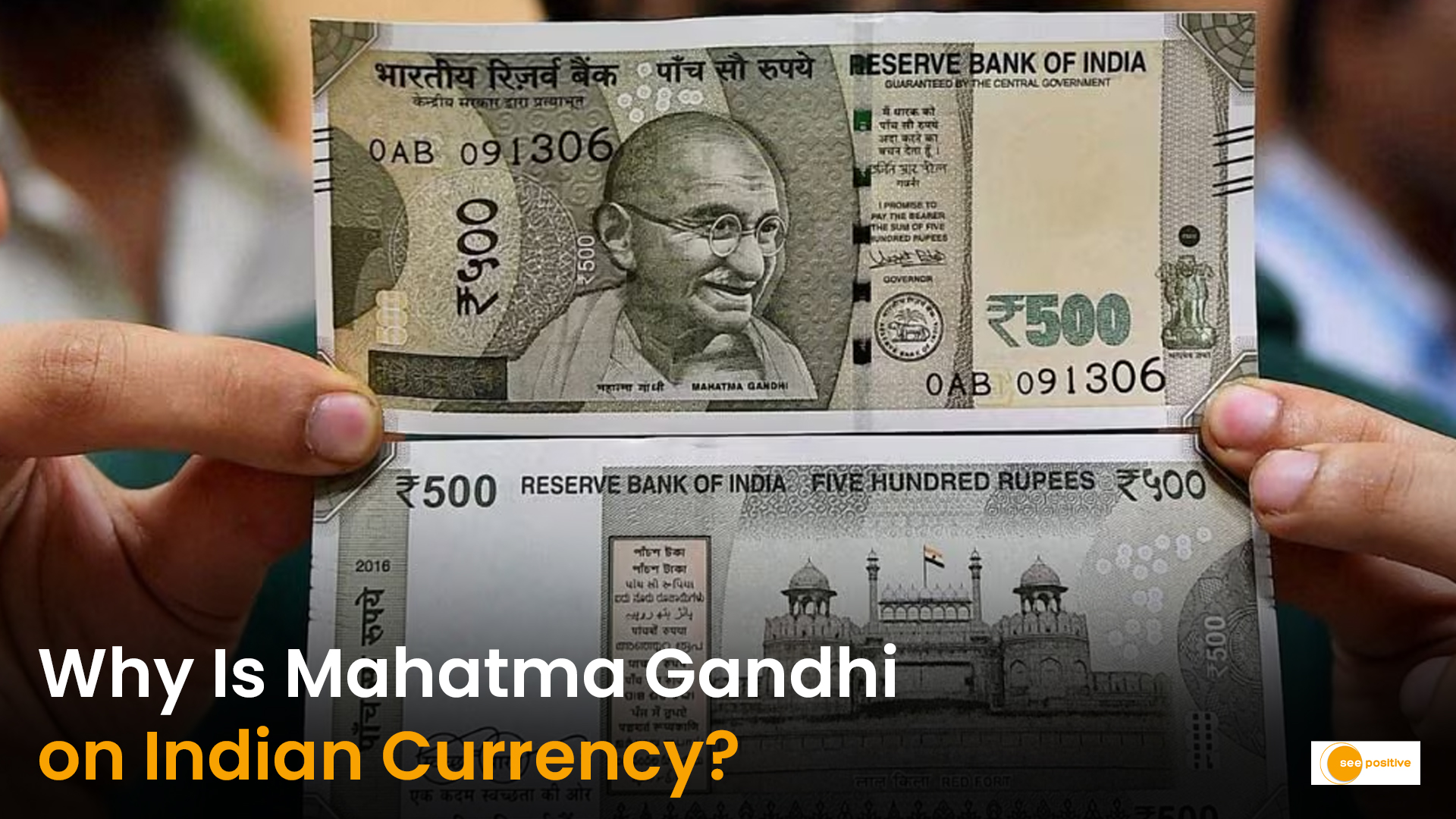
For millions of Indians, Mahatma Gandhi’s face is instantly associated with money. But Gandhi was not always the face of the Indian rupee. His journey onto India’s banknotes took several decades and involved history, national identity, currency design and security technology.
Every time we pay for a cup of tea, withdraw cash from an ATM or receive a ₹500 note, we see the same familiar face—Mahatma Gandhi.
So familiar is his portrait that it may seem as though Gandhi has always been present on Indian currency. But that assumption is incorrect.
The story of Mahatma Gandhi on Indian banknotes is far more interesting. His portrait appeared on selected notes decades before it became a standard feature, and the transformation took place gradually.
Gandhi Was Not on India’s First Post-Independence Currency
After India became independent in 1947, the country began the process of creating a visual identity for its new currency.
The first banknote issued by independent India was the ₹1 note in 1949. Instead of carrying the portrait of Mahatma Gandhi, it featured the Lion Capital of Ashoka at Sarnath.
For many years, Indian banknotes used national symbols, monuments, agricultural themes, scientific achievements and other imagery representing the country’s identity and development.
Gandhi’s portrait was not initially chosen as the standard face of Indian currency.
1969: Gandhi Appears on Indian Currency
A major change came in 1969, the centenary year of Mahatma Gandhi’s birth.
The Reserve Bank of India issued commemorative notes featuring Gandhi. Among them was a ₹100 note showing Gandhi seated, with Sevagram Ashram in the background.
This was an important milestone, but Gandhi had still not become the permanent face of Indian currency.
His appearance at this stage was connected with commemorative issues rather than a complete redesign of India’s regular banknotes.
1987: Gandhi Returns on the ₹500 Note
Nearly two decades later, Gandhi appeared again in a much more significant way.
In October 1987, the Reserve Bank of India introduced a new ₹500 banknote featuring Mahatma Gandhi’s portrait.
The note also incorporated the Ashoka Pillar watermark, reflecting the growing importance of security features in Indian currency.
This was another step toward the Gandhi portrait becoming a familiar element of India’s banknotes.
1996: The Mahatma Gandhi Series
The biggest transformation came in 1996.
The Reserve Bank of India introduced the Mahatma Gandhi Series, beginning with denominations such as the ₹10 and ₹100 notes.
Gandhi’s portrait became a standard feature on regular Indian banknotes.
This is why 1996 is often regarded as the turning point in the history of Gandhi’s image on Indian currency.
However, there is an important distinction: Gandhi had appeared on Indian notes before 1996. What changed in 1996 was that his portrait became part of the standard design of India’s regular banknotes.
Why Was Gandhi Chosen?
The decision was not simply about putting the country’s most famous freedom leader on its money.
Mahatma Gandhi represented India’s freedom struggle and had a unique association with the country’s history. His philosophy of non-violence and his role in India’s independence movement made him an instantly recognisable national figure.
But his portrait also had a practical purpose.
According to the Reserve Bank of India, portraits can contribute to banknote security. The intricate details of a human face are difficult to reproduce accurately, making engraved portraits useful as an anti-counterfeiting feature.
So Gandhi’s image served both a symbolic and technical purpose.
The Interesting Story Behind the Portrait
There is another fascinating detail about the Gandhi portrait found on Indian banknotes.
It was not simply an artist’s imagination of Gandhi.
The portrait is based on a photograph taken in Delhi in 1946, during the final years of the freedom struggle. The photograph was later adapted and cropped to create the image used on Indian currency.
That means the face seen on today’s notes is connected to an actual photograph from India’s history.
Gandhi’s Portrait Survived Multiple Currency Redesigns
Indian currency has changed significantly since the 1990s.
New colours, designs, motifs and security features have been introduced over the years. The Reserve Bank of India also launched the Mahatma Gandhi Series 2005 with additional security features.
Later, the Mahatma Gandhi New Series brought another major redesign of Indian banknotes.
Yet through these changes, Gandhi’s portrait remained.
The design of the note evolved, but the familiar face stayed.
From a Freedom Fighter to the Face of Indian Currency
The journey can be traced through a few important milestones:
1949 — Independent India’s first ₹1 note features the Lion Capital of Ashoka.
1969 — Gandhi appears on commemorative Indian banknotes during his birth centenary year.
1987 — Gandhi’s portrait appears on the ₹500 banknote.
1996 — The Mahatma Gandhi Series makes his portrait a standard feature on regular Indian banknotes.
2005 onwards — New security features and redesigned notes continue to retain Gandhi’s portrait.
Why This Story Matters
The face on an Indian banknote is more than just a portrait.
It represents the intersection of India’s history, national identity, currency design and modern security technology.
Mahatma Gandhi did not become the face of the Indian rupee overnight. His image appeared gradually, through commemorative issues and later regular banknote series, before becoming the defining portrait of Indian currency.
So the next time you hold a ₹100 or ₹500 note, take a closer look.
That familiar face carries a story that began decades ago—and one that connects India’s freedom movement with the modern technology of money.

