

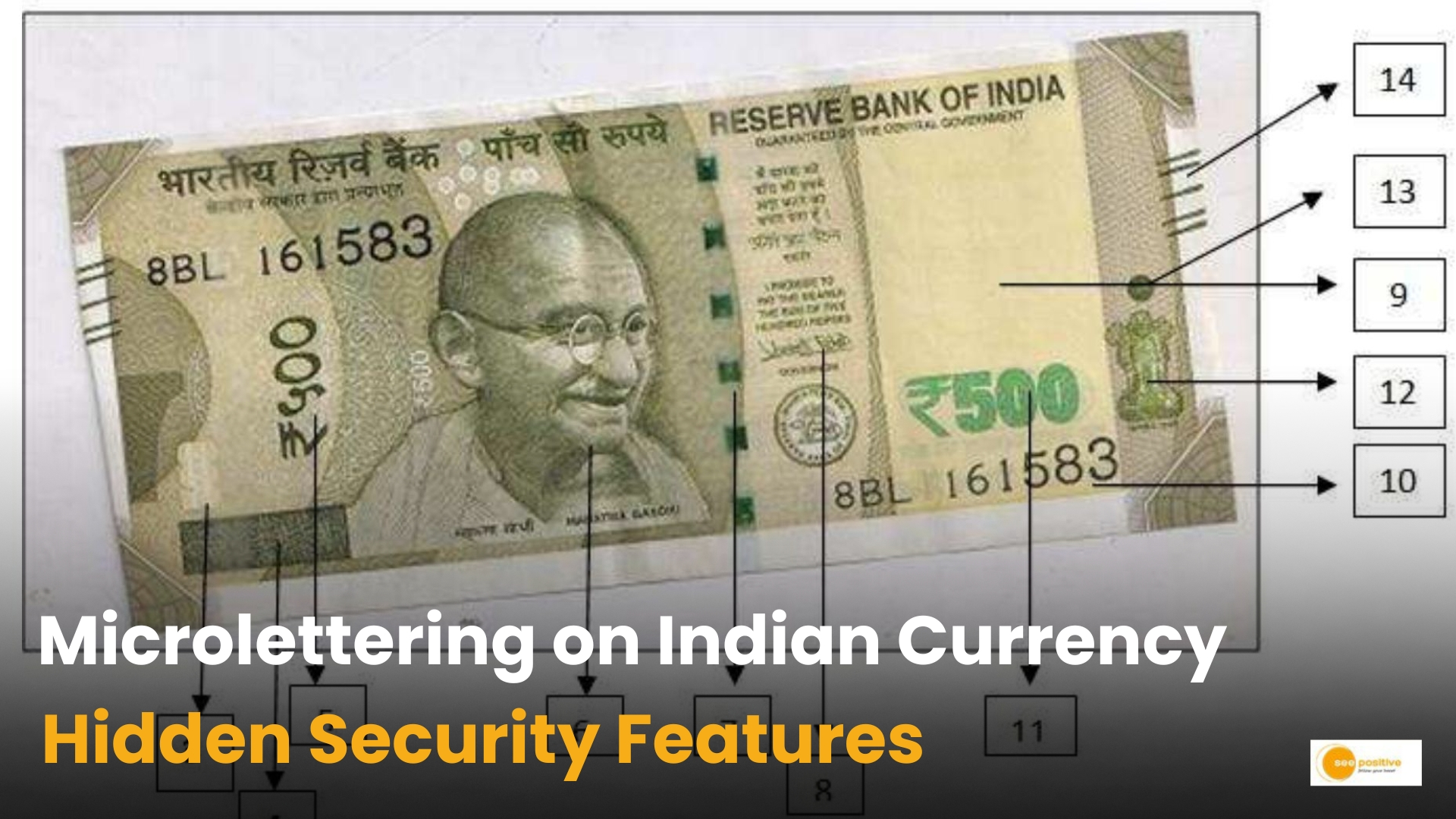
Every Indian currency note contains multiple security features designed to protect it from counterfeiting. While most people recognize visible features like the watermark, security thread, and Mahatma Gandhi portrait, one of the most overlooked security elements is microlettering.
Microlettering is a highly precise printing technique that incorporates tiny text into the design of a banknote. These microscopic letters are difficult to reproduce using conventional printing methods, making them an effective layer of protection against counterfeit currency.
In this article, we explain what microlettering is, where it appears on Indian rupee notes, why it is used, and how it contributes to the security of India’s currency.
What Is Microlettering on Indian Rupee Notes?
Microlettering, also known as microprinting, is a security printing technique in which extremely small letters or numbers are printed on a banknote. The text is intentionally designed to be too small to read comfortably with the naked eye.
On genuine Indian currency notes, the microprinted text is produced using high-precision printing technology. Under magnification, the letters appear clear, sharp, and well-defined.
Because of the precision required, accurately reproducing microlettering is challenging for counterfeiters, making it an important anti-counterfeiting feature.
Where Is Microlettering Located?
In the Mahatma Gandhi (New) Series of Indian banknotes, microlettering is positioned near the portrait of Mahatma Gandhi. Depending on the denomination, its exact placement may vary slightly, but it is generally found between Gandhi’s portrait and the security thread or in the area adjacent to the portrait.
Examples include:
₹100 Note
Contains the microprinted text “RBI” and “100.”
₹200 Note
Contains “RBI” and “200.”
₹500 Note
Contains “RBI” and “500.”
The Reserve Bank of India (RBI) may adjust the placement of security features across different series or denominations while maintaining their purpose.
Can You See Microlettering Without Magnification?
In most cases, no.
The letters are extremely small and are generally intended to be viewed using:
- A magnifying glass (approximately 10× magnification)
- A smartphone equipped with a macro camera or macro lens
- A microscope for detailed examination
Without magnification, the text often appears as a fine line or a small printed pattern.
Why Does the RBI Use Microlettering?
Microlettering serves as one of several security features that help protect Indian currency from counterfeiting.
Its primary advantages include:
- Requires high-precision printing technology.
- Is difficult to reproduce accurately using standard printers or photocopiers.
- Helps distinguish genuine banknotes from many counterfeit copies when examined under magnification.
- Adds another layer of authentication alongside other security features.
Rather than relying on a single feature, the RBI incorporates multiple security elements into every banknote to improve overall security.
How Does Microlettering Help Detect Counterfeit Notes?
When examined under magnification:
Genuine banknotes typically display:
- Crisp lettering
- Clearly readable text
- Uniform spacing
- Sharp edges
In contrast, counterfeit notes often exhibit:
- Blurred printing
- Broken or merged letters
- Irregular spacing
- Poor print quality
However, the RBI advises that no single security feature should be used to determine whether a banknote is genuine. Multiple security features should always be checked together.
Other Important Security Features on Indian Rupee Notes
Microlettering is only one component of India’s banknote security system. Other important features include:
Watermark
A multi-tone image of Mahatma Gandhi and the denomination becomes visible when the note is held against light.
Security Thread
A partially embedded security thread contains inscriptions such as “भारत,” “RBI,” and the denomination, depending on the series.
See-Through Register
Partial patterns printed on both sides of the note align perfectly when viewed against light to form the denomination.
Intaglio Printing
Raised printing allows important elements—including Mahatma Gandhi’s portrait, the Reserve Bank seal, and identification marks—to be felt by touch.
Latent Image
On higher denomination notes, the denomination can be viewed from certain angles through a latent image feature.
Colour-Shifting Ink
On the ₹500 note, the denomination printed in optically variable ink changes colour when the viewing angle changes.
Identification Marks
Raised tactile marks help visually impaired individuals identify different denominations.
Interesting Facts About Microlettering
- Microlettering is measured in fractions of a millimetre.
- It is a widely used security feature on banknotes around the world.
- Many countries, including the United States, the United Kingdom, Japan, and India, incorporate microprinting into their currency designs.
- High-resolution commercial printers generally cannot reproduce genuine microlettering with the same level of clarity as security printing presses.

