

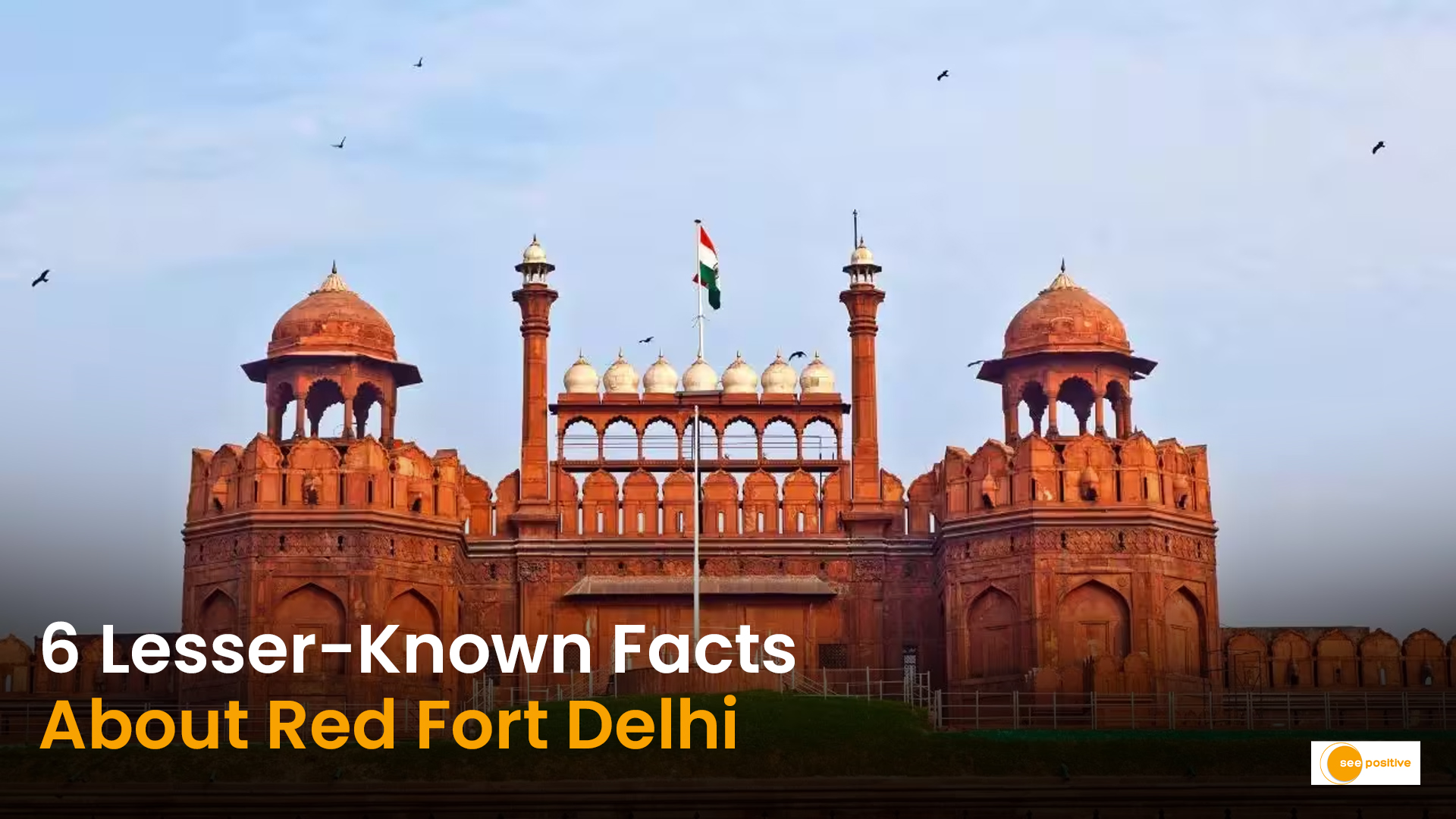
Delhi’s Red Fort, popularly known as Lal Qila, is much more than a monument associated with India’s Independence Day celebrations. Built during the reign of Mughal emperor Shah Jahan, the fort was designed as the palace-fort of Shahjahanabad, his new imperial capital.
Construction began in the 17th century and the complex became one of the most impressive expressions of Mughal architecture. Today, the Red Fort is a UNESCO World Heritage Site, recognised for its architectural and historical importance.
But beyond its famous red sandstone walls are several details that are easy to miss. Here are six lesser-known facts that make the Red Fort even more fascinating.
1. The Red Fort Was Originally Called Qila-i-Mubarak
Before it became widely known as the Red Fort or Lal Qila, the complex was known as Qila-i-Mubarak, meaning the “Blessed Fort.”
It was essentially a royal residence and palace-fort for the Mughal imperial family. The fort was closely connected with Shah Jahan’s new capital, Shahjahanabad, which developed into what is now Old Delhi.
2. The Fort Was Designed Around a ‘Stream of Paradise’
One of the most interesting features inside the Red Fort is the Nahr-i-Behisht, or “Stream of Paradise.”
This water channel was incorporated into the palace complex and connected several royal buildings. Water was not merely a practical element in the design; it was also an important part of the Mughal vision of an ideal, paradise-like royal environment. The Ministry of Culture identifies the Nahr-i-Behisht as a defining feature linking the fort’s elegant pavilions.
3. The Red Fort Is Not Perfectly Symmetrical
Despite its grand and carefully planned appearance, the Red Fort does not follow a perfectly symmetrical geometric plan.
The complex has an octagonal layout, with its longer axis running north-south. Its massive defensive walls extend for about 2.4 kilometres, while the fort’s position beside the Yamuna also influenced its overall planning.
This combination of defensive planning, palace architecture and landscaped spaces is one of the reasons the Red Fort is considered an important achievement of Mughal architectural design.
4. The Fort Complex Once Had a Much Larger Number of Buildings
The Red Fort visitors see today represent only part of the original Mughal complex.
Following the events of 1857, the British took control of the fort and converted it into a military stronghold. Numerous historic structures were demolished to make space for military barracks and other constructions. The government records note that many of the original buildings were replaced during the British period.
This means that the present-day Red Fort is not exactly the same palace city that Shah Jahan and the Mughal court once occupied.
5. The Fort Was Connected With the Older Salimgarh Fort
The Red Fort did not stand in isolation.
It was planned alongside the much older Salimgarh Fort, which dates to the 16th century. The Red Fort complex incorporated the older fort into its overall setting, creating a larger historical landscape.
According to the Ministry of Culture, the planning of the Red Fort and its relationship with Salimgarh demonstrate the sophisticated approach taken by the Mughals toward fortification, gardens and urban planning.
6. Its Architecture Is a Blend of Multiple Traditions
The Red Fort is often described simply as an example of Mughal architecture, but its design represents a broader cultural synthesis.
The Ministry of Culture describes the complex as reflecting Persian, Timurid and Hindu architectural traditions. Its red sandstone walls, marble pavilions, gardens, ornamental work and water channels collectively created the distinctive Shahjahani architectural style.
This combination is what makes the Red Fort more than just a military structure. It was simultaneously a fortress, royal residence, ceremonial space and expression of imperial power.
Why the Red Fort Still Matters
The historical significance of the Red Fort extends far beyond the Mughal period. It witnessed major turning points in India’s history, including the upheavals of 1857 and the subsequent British occupation.
After Independence, the fort acquired another powerful identity. Jawaharlal Nehru hoisted the national flag at the Lahori Gate on 15 August 1947, and the monument has since remained closely associated with India’s Independence Day tradition.
The Red Fort was inscribed as a UNESCO World Heritage Site in 2007, recognising its outstanding cultural and architectural significance.
Quick SEO FAQ
Who built the Red Fort in Delhi?
The Red Fort was commissioned by Mughal emperor Shah Jahan as the palace-fort of his new capital, Shahjahanabad.
When was the Red Fort built?
Construction began in the late 1630s and the main complex was completed in the 1640s. Government sources give 1639–1648 for its construction.
Why is it called the Red Fort?
The monument is popularly known as Lal Qila or Red Fort because of its imposing red sandstone fortification walls.
Is the Red Fort a UNESCO World Heritage Site?
Yes. The Red Fort Complex was inscribed on the UNESCO World Heritage List in 2007.
What is Nahr-i-Behisht?
Nahr-i-Behisht, meaning “Stream of Paradise,” is the historic water channel that formed an important part of the Red Fort’s palace design.

