

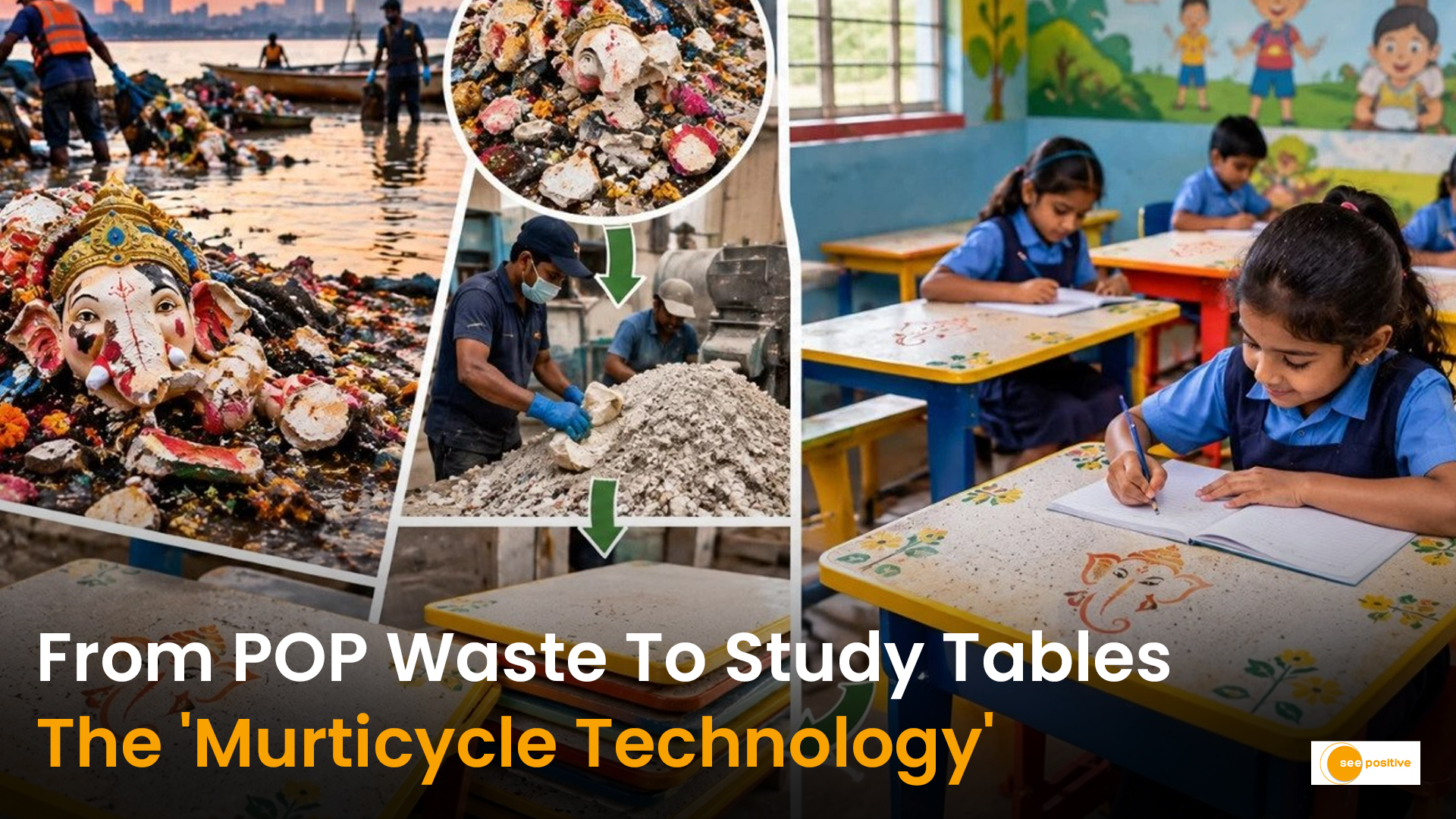
Every year, the vibrant festival of Ganesh Chaturthi concludes with Ganpati Visarjan. While it marks the end of grand celebrations, it leaves behind a massive environmental challenge. In Mumbai alone, around 1.5 lakh Plaster of Paris (POP) idols are immersed in water bodies annually, generating nearly 675 tonnes of POP waste. Because POP does not dissolve easily in water, broken pieces of idols remain stranded on shores long after the crowds disperse.
However, two change-makers, Malhar Kaalambe and Dr. Binish Desai, decided to look at this environmental issue differently. They asked a simple question: What if a broken idol could be useful again?
What is Murticycle Technology for POP Recycling?
Instead of treating leftover POP as festival waste, Malhar partnered with Gujarat-based innovator Dr. Binish Desai, known as the “Recycle Man of India.” Dr. Desai developed an innovative recycling process called Murticycle technology.
Through this process, volunteers collect the broken idols left behind on Mumbai’s beaches and separate the raw POP material. Instead of letting the waste pollute marine ecosystems, Murticycle technology processes the discarded Plaster of Paris and transforms it into 12 different useful, everyday items.
Turning Recycled POP Idols into Study Tables
Among all the products created from recycled POP waste, one holds a particularly special purpose: study desks for students. Over the past two years, Malhar and Dr. Desai have successfully recycled more than 3,200 kg of POP waste. Using this material, they have manufactured 760 recycled study tables for underprivileged children across Maharashtra.
Many of these children previously lacked a dedicated space to sit, read, and write. Now, the material that was once part of a Ganpati idol provides them with a sturdy desk for their education. Festival waste has found a meaningful new home in classrooms and home study corners.
Environmental Impact and Carbon Offset
Beyond supporting child education, this initiative delivers a massive win for the environment. Recycling POP prevents hazardous materials from clogging Mumbai’s coastline and oceans.
Furthermore, manufacturing these recycled POP tables offers direct climate benefits: each study table produced saves approximately 5,457 grams of CO₂ emissions compared to traditional manufacturing.
A Sustainable Future for Festival Traditions
Ganpati’s journey does not have to end at visarjan. The work of Malhar Kaalambe and Dr. Binish Desai proves that through eco-friendly innovation, we can solve critical environmental problems while supporting local communities. A broken idol can become a durable table, a table can become a child’s learning space, and festival waste can ultimately help build a child’s future!

