

Symbols are everywhere. They appear on flags, buildings, road signs, clothing, technology and even everyday messages. Some have existed for thousands of years, while others were created only within the last century.
But many of the symbols we instantly recognize have fascinating histories that are very different from what people might expect.
From the peace symbol to the Olympic rings, here are 10 famous symbols and the surprising stories behind them.
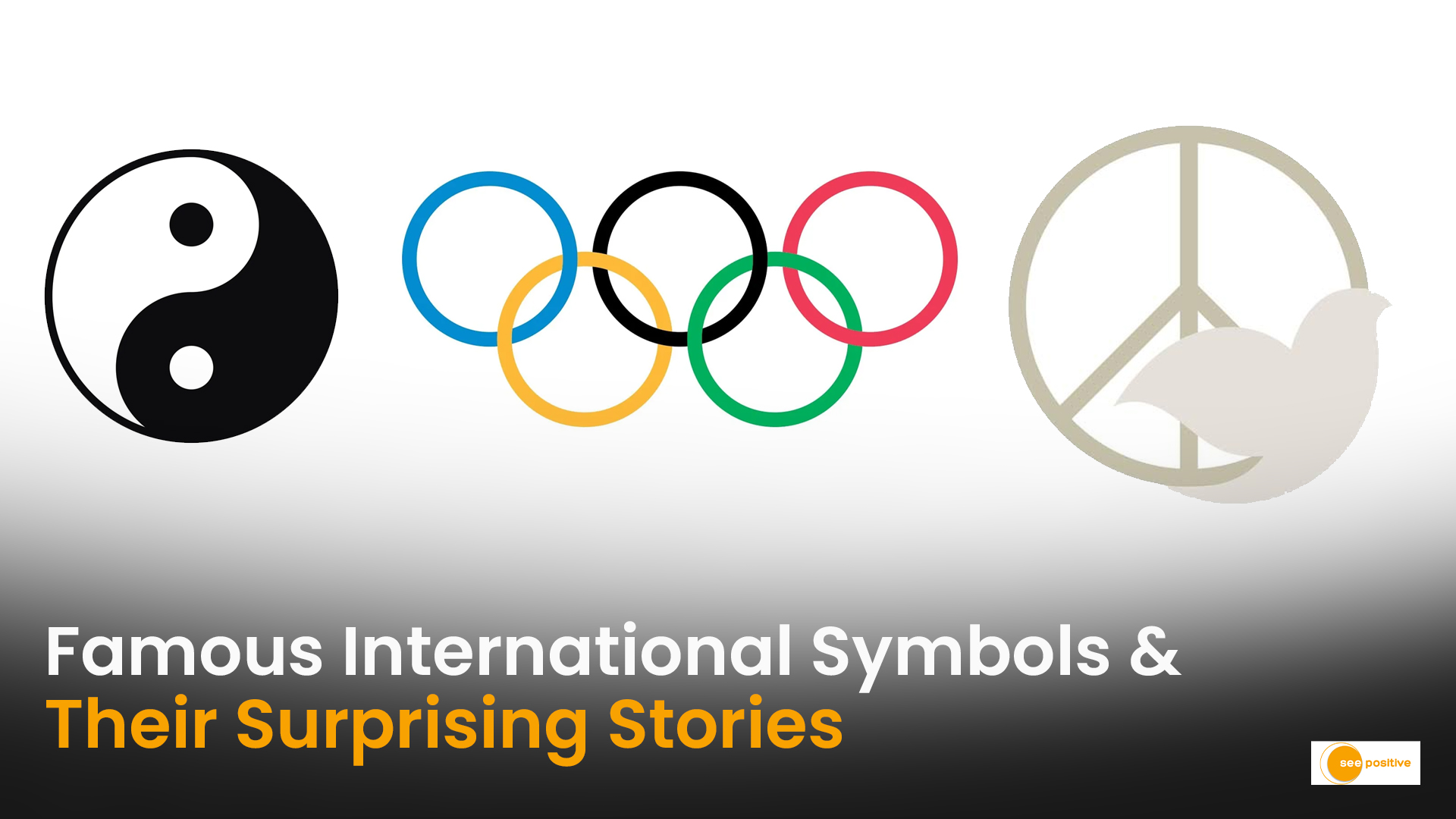
1. ☮️ The Peace Symbol Was Created for Nuclear Disarmament
Today, the peace symbol is recognized around the world as a sign of peace and nonviolence.
But it was originally created for a specific political campaign.
British designer Gerald Holtom created the symbol in 1958 for the Campaign for Nuclear Disarmament (CND). The design incorporated semaphore signals representing the letters “N” and “D,” standing for nuclear disarmament.
The symbol eventually moved beyond the nuclear-disarmament movement and became a global representation of peace.
2. 🏳️🌈 The Rainbow Flag Began as a Handmade Design
The rainbow flag is now one of the world’s most recognizable symbols of LGBTQ+ pride.
Artist and activist Gilbert Baker designed the first widely recognized rainbow flag in 1978 for San Francisco’s Gay Freedom Day celebrations.
The original design contained more colors than the version commonly seen today. Over time, the design was simplified, eventually becoming the familiar rainbow pattern.
What began as a local artistic project grew into an internationally recognized symbol of pride and equality.
3. ☯️ The Yin-Yang Symbol Is About Balance
The black-and-white yin-yang symbol is closely associated with Chinese philosophy.
Known as taijitu, it represents the complementary relationship between yin and yang. The two sides are not simply “good” and “evil.”
Instead, they represent opposing but interconnected forces—such as darkness and light, stillness and movement.
The small circle of each color inside the opposite section reinforces the idea that each force contains an element of the other.
4. ⚕️ The Medical Symbol Has an Ancient Greek Connection
The staff and snake associated with medicine have roots in ancient Greece.
The Rod of Asclepius features a single snake wrapped around a staff. Asclepius was associated with healing in ancient Greek religion.
Over centuries, the image became connected with medicine and healthcare.
There is also another similar symbol—the caduceus, which has two snakes and wings. Although often used in modern contexts to represent medicine, its historical connection is actually to Hermes and commerce rather than healing.
5. 🗽 The Statue of Liberty Was Inspired by Classical Imagery
The Statue of Liberty is one of the most famous symbols of freedom in the world.
France presented the statue to the United States, and it was dedicated in 1886.
The figure is often associated with Roman representations of liberty and carries a torch representing enlightenment. She also holds a tablet bearing the date of the U.S. Declaration of Independence.
Over time, the monument became particularly associated with immigrants arriving in the United States.
6. 🏅 The Olympic Rings Represent Global Unity
The five interlocking Olympic rings are among the most recognizable symbols in international sport.
They were designed by Pierre de Coubertin, one of the founders of the modern Olympic movement.
The rings’ interlocking arrangement represents the coming together of athletes and nations through the Olympic Games.
The five rings correspond to the five parts of the world involved in the Olympic movement at the time of their creation.
A common misconception is that each individual ring color officially represents a specific continent. That is not the official meaning of the colors.
7. ♻️ The Recycling Symbol Was Born From a Design Contest
The familiar three-arrow recycling symbol is surprisingly modern.
It was created in 1970 by American student Gary Anderson after he entered an environmental design competition organized around the first Earth Day.
The three arrows form a continuous loop, representing the concept of materials being collected, processed and reused.
The symbol quickly became associated with the growing environmental movement.
8. ❤️ The Heart Shape Doesn’t Look Like a Real Heart
The human heart is not shaped like the familiar symbol we use to represent love.
So where did the ❤️ shape come from?
There is no single confirmed explanation.
Various theories connect the shape to ancient artistic representations, medieval manuscripts and even the shape of certain leaves or seeds. Another historical association involves the silphium plant, which was used in the ancient Mediterranean and whose seedpod has sometimes been compared with the heart symbol.
Whatever its exact origin, the stylized heart gradually became strongly associated with romantic love.
9. 👁️ The Eye of Providence Is Older Than Its Most Famous Appearance
The Eye of Providence—a single eye inside a triangle—is often recognized because it appears on the reverse side of the Great Seal of the United States.
The symbol, however, did not originate with the United States.
The eye has older religious and artistic associations with divine observation and providence. The triangle can also carry Christian associations with the Trinity.
Its inclusion on the Great Seal helped make the image much more recognizable in modern times.
10. 🕊️ The Dove Became a Global Symbol of Peace
The dove has been associated with peace for centuries.
Its symbolism can be found in ancient traditions and religious stories. In the biblical account of Noah, a dove returns carrying an olive leaf, signaling that the floodwaters were receding.
The connection between the dove and modern peace movements became even stronger in the 20th century.
Artist Pablo Picasso famously created dove imagery for peace-related movements, helping turn the simple bird into one of the world’s most recognizable symbols of peace.
Why Do Symbols Become So Powerful?
The power of a symbol comes from its ability to communicate an idea without requiring words.
A simple image can represent freedom, peace, love, equality, medicine, environmental responsibility or international cooperation.
Some symbols evolved over centuries. Others were deliberately designed for a particular movement or event and later took on a much broader meaning.
That is what makes their histories so fascinating.
The Stories Behind Symbols Are Often More Interesting Than the Symbols Themselves
The next time you see a peace sign, Olympic rings, rainbow flag or medical symbol, remember that you’re looking at more than just an image.
Each symbol carries a story shaped by culture, history, religion, politics, art and human creativity.
Some are thousands of years old. Others were created within living memory.
Together, they show how a simple design can travel across borders and generations—and become part of the shared visual language of the world.

