

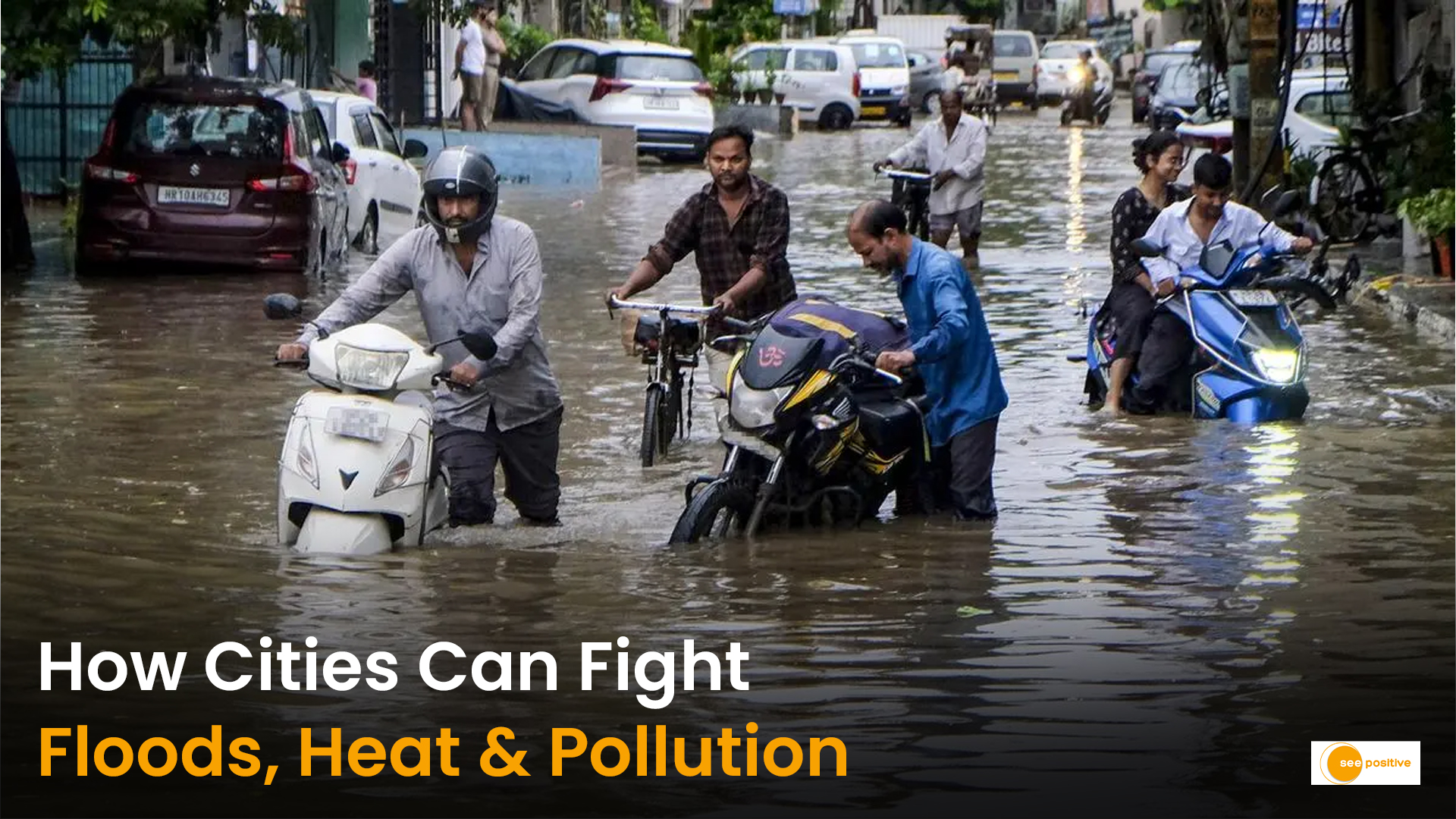
Climate change is making extreme weather events more frequent and intense, while rapid urbanisation is putting additional pressure on natural ecosystems. From urban flooding and extreme heat to air pollution and water stress, cities across the world are facing interconnected environmental challenges.
One approach gaining increasing attention is Nature-based Solutions (NbS) — using, protecting and restoring natural ecosystems to address societal and climate-related challenges.
Wetlands, mangroves, urban forests, lakes, green corridors, rain gardens and sponge parks can all play a role in making cities more resilient. Importantly, these solutions can work alongside conventional infrastructure rather than replacing it completely.
India is also beginning to explore this approach, with cities including Chennai, Bhubaneswar, Mumbai, Kochi and several cities along the Ganga and its tributaries incorporating or planning nature-based interventions for climate resilience.
What Are Nature-Based Solutions?
Nature-based Solutions refer to actions that protect, restore or sustainably manage ecosystems to address challenges faced by society while also benefiting biodiversity.
The International Union for Conservation of Nature (IUCN) describes NbS as actions that address societal challenges through the protection, sustainable management and restoration of natural or modified ecosystems while providing benefits for both people and biodiversity.
In urban areas, this could mean restoring a wetland instead of filling it, preserving a natural drainage channel instead of replacing it entirely with concrete, or creating a sponge park that temporarily stores rainwater during heavy rainfall.
The concept is increasingly relevant because natural ecosystems can perform functions that cities often try to replicate through expensive engineered infrastructure.
How Can Nature Help Control Urban Flooding?
One of the biggest applications of Nature-based Solutions is urban flood management.
As cities expand, natural surfaces are increasingly replaced by roads, buildings and concrete. These impermeable surfaces prevent rainwater from soaking into the ground and increase surface runoff.
Wetlands, ponds, floodplains, rain gardens and other natural or semi-natural landscapes can absorb, store and slow down rainwater.
This is the basic principle behind the emerging “sponge city” approach — allowing urban landscapes to absorb and temporarily hold water rather than moving all rainfall through drains as quickly as possible.
Chennai’s Sponge Parks
Chennai is emerging as one of India’s prominent examples of sponge-based urban infrastructure.
A 2026 NITI Aayog Frontier Tech case study highlights sponge parks in Chennai as an example of blue-green infrastructure and Nature-based Solutions for urban flood management.
In the Porur area, a 16-acre project has combined a restored wetland with interconnected ponds and vegetated filtration systems. The project was designed to detain stormwater during heavy rainfall while also creating public recreational space.
According to the NITI Aayog case study, the Chennai sponge-park projects have demonstrated the potential to manage around 90% of stormwater runoff and store more than 30 million litres of water at the documented sites.
The project illustrates an important principle: the same urban space can function as both public infrastructure and ecological infrastructure.
Bhubaneswar Is Developing a City-Wide Nature-Based Flood Strategy
Bhubaneswar provides another significant Indian example.
The National Institute of Urban Affairs (NIUA) developed a strategy for flood management in Bhubaneswar using Nature-based Solutions under its Proliferating Ecosystem-based Adaptation Practices in Indian Cities (EPIC) project.
The city was assessed for flood-prone areas as well as its existing natural ecosystems. Based on the assessment, site-specific Nature-based interventions were proposed for 12 critical locations.
The proposed approaches include:
- Sponge parks
- Constructed wetlands
- Drain restoration
- Riparian buffers
- Blue-green public spaces
- Restoration of urban water ecosystems
The significance of Bhubaneswar’s approach lies in treating the city’s natural ecosystems as part of its flood-management infrastructure rather than viewing them as separate from urban planning.
Mumbai Is Looking at Sponge Parks and Bioswales
Mumbai’s exposure to intense rainfall and urban flooding has also pushed the city towards blue-green infrastructure.
The Brihanmumbai Municipal Corporation’s flood-mitigation proposals have included interventions such as sponge parks, bioswales and detention and filtration systems as part of a broader strategy to strengthen the city’s drainage and flood resilience.
Mumbai is also among the Indian cities where Nature-based Solutions have been explored through projects involving urban greenery, water-body restoration and other ecosystem-based interventions.
WRI India has worked with local governments and community organisations in Mumbai, Kochi and Jaipur, developing 30 Nature-based projects across the three cities. These included water-body restoration, tree planting, stream rejuvenation, wastewater treatment and urban and rooftop farming.
Kochi: Using Nature to Address Multiple Climate Risks
Kochi is another city where Nature-based Solutions have been explored as part of climate resilience planning.
The city faces a combination of urban flooding, extreme heat and water-related challenges. WRI’s work in Kochi has included interventions such as water-body restoration, tree planting, stream rejuvenation and other community-oriented Nature-based projects.
This demonstrates one of the major advantages of NbS: a single project can potentially address more than one environmental challenge.
For example, restoring a water body may improve water retention while also creating habitat and public space. Increasing urban vegetation can provide shade while supporting biodiversity.
Nature-Based Solutions and Extreme Heat
Flooding is not the only climate challenge where nature can help.
Trees, parks, wetlands and green corridors can provide shade and cooling through evapotranspiration.
The Government of India’s Ministry of Housing and Urban Affairs has identified measures such as urban green cover, native tree plantations, urban forests, green corridors, wetland buffers and restoration of rivers and lakes as part of the broader response to urban heat.
Under the AMRUT 2.0 programme, the government has also initiated a pilot programme to scientifically assess urban heat mitigation in 12 cities, including Bengaluru, Bhopal, Dehradun, Gwalior, Gurugram, Guwahati, Jodhpur, Ludhiana, Nashik, Vadodara and Visakhapatnam. The assessments include recommendations related to urban greening and water-sensitive planning.
Trees Can Help, But They Are Not a Complete Air-Pollution Solution
Urban vegetation can contribute to improved environmental conditions, but it is important not to overstate what trees can achieve.
Trees and plants can intercept some airborne particles, provide shade and influence local microclimates. However, planting trees cannot substitute for controlling emissions from vehicles, industries, construction and other sources.
Nature-based interventions should therefore be considered one component of a broader clean-air strategy.
The most effective approach combines emission reduction with better public transport, cleaner energy, waste management and appropriately planned urban greenery.
Mangroves: A Natural Defence Against Coastal Hazards
For coastal cities, mangroves are among the most important natural ecosystems for climate resilience.
Their complex root systems help trap sediment, reduce erosion and weaken the force of waves. They also provide habitat for numerous species and support coastal livelihoods.
Mangrove conservation can therefore deliver several benefits at once — coastal protection, biodiversity conservation, carbon storage and livelihood support.
The principle is particularly relevant to India’s long coastline, where coastal cities face increasing exposure to extreme weather and sea-level-related risks.
India’s Cities Are Moving Towards Blue-Green Infrastructure
Nature-based urban planning is no longer limited to isolated tree-planting programmes.
Government and institutional projects across India increasingly use terms such as blue-green infrastructure, sponge landscapes, bioswales, constructed wetlands, riparian restoration and ecological drain rejuvenation.
A recent Government of India update on Urban River Management Plans highlights Nature-based interventions in cities across Uttarakhand, Uttar Pradesh and Bihar.
For example, Haldwani-Kathgodam’s planning includes riparian buffers and flood-management interventions around the Gaula River. Rishikesh’s approach includes rejuvenation of tributaries and wetlands, while Gorakhpur’s plan includes sponge parks, bioswales, constructed wetlands and ecological riverfronts.
These examples show that Nature-based Solutions are increasingly being incorporated into river management, flood control, pollution reduction and urban planning.
What Can Indian Cities Learn From These Examples?
The experiences of Indian cities point towards several important lessons.
1. Protect Existing Natural Ecosystems
It is often more effective to protect an existing wetland, lake, river channel or forest than to recreate the same ecological function later.
2. Make Water Bodies Part of City Planning
Urban lakes, ponds and wetlands should not be treated merely as decorative features. They can form part of a city’s stormwater and water-management system.
3. Combine Green and Grey Infrastructure
Drainage systems, flood barriers and pumping infrastructure may still be necessary. Nature-based interventions can complement these systems by reducing the amount of water that reaches them during extreme events.
4. Use Local Ecosystems
A solution that works in Chennai may not be directly transferable to a dry city such as Jodhpur. Local rainfall, soil, vegetation, hydrology and biodiversity must determine the design.
5. Plan for Maintenance
A rain garden, wetland or urban forest cannot remain effective without maintenance. Long-term monitoring and community participation are therefore essential.
Are Nature-Based Solutions Better Than Concrete Infrastructure?
The answer depends on the specific location and problem.
Nature-based and engineered infrastructure serve different functions and can often work best together.
For example, a city may need stormwater drains to manage extreme rainfall, but restoring upstream wetlands can reduce the amount and speed of water entering those drains.
Similarly, an urban forest cannot replace an entire heat-management strategy, but it can complement cool roofs, building design, public cooling centres and heat-action plans.
The National Institute of Urban Affairs notes that Nature-based Solutions can serve as important complementary measures to engineering approaches, particularly for challenges such as urban flooding and water scarcity.
The Future of Climate-Resilient Cities
The growing interest in Nature-based Solutions reflects a broader change in how cities think about infrastructure.
A wetland can be flood infrastructure.
A tree canopy can be heat infrastructure.
A restored lake can be water infrastructure.
A mangrove forest can be coastal protection.
A green corridor can be biodiversity and cooling infrastructure.
The challenge is to design these ecosystems carefully, protect them from encroachment and pollution, and integrate them into long-term city planning.
For India, where rapid urbanisation is occurring alongside rising climate risks, Nature-based Solutions offer an opportunity to make urban development more resilient while also improving biodiversity and quality of life.
The future of sustainable cities may therefore not be about choosing nature or infrastructure.
It may be about learning how to make nature and infrastructure work together.

