

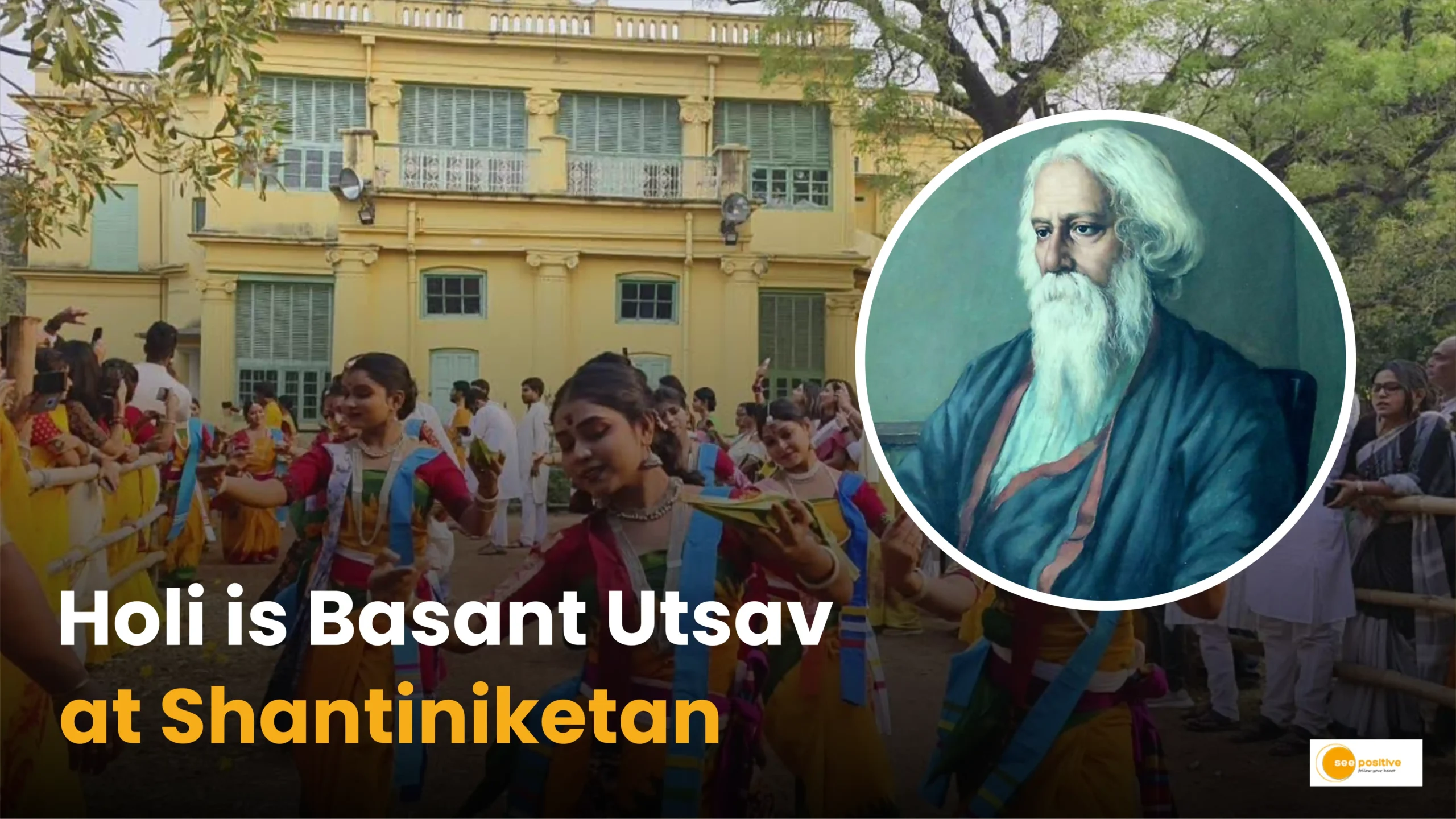
When most of India celebrates Holi with vibrant clouds of gulal and playful splashes of color, Shantiniketan welcomes spring in a way that feels softer, poetic, and deeply spiritual. Here, at Shantiniketan Holi transforms into Basanta Utsav (Spring Festival) started by Tagore. Its a celebration not just of colors, but of culture, nature, music, and inner joy. To experience Basant Utsav (Holi) in Shantiniketan is to feel as though you have stepped into a living poem—one written by none other than Rabindranath Tagore himself. Shantiniketan comes alive every spring with Holi celebrations inspired by Rabindranath Tagore’s vision of art and culture.
Shantiniketan: The Abode of Peace
A global learning hub by Tagore himself
The very name Shantiniketan means “abode of peace,” and that is exactly what this small university town radiates. Founded as an educational and cultural center by Tagore’s father, and later developed into a global learning hub by Tagore himself through Visva-Bharati University, Santiniketan was envisioned as a place where learning happens in harmony with nature.
Classes were traditionally held under open skies, beneath trees, where students could feel the rhythm of the seasons. It is no surprise then that spring—the season of renewal—became such an important celebration here.
The Vision of Rabindranath Tagore
Rabindranath Tagore, Nobel Laureate and one of India’s greatest literary minds, believed education should nurture creativity and cultural awareness. For him, festivals were not mere rituals; they were expressions of life itself.
He introduced Basanta Utsav in Shantiniketan as a refined and artistic celebration of Holi—one that blended music, dance, poetry, and devotion. Inspired by ancient Indian traditions and the spirit of universal harmony, Tagore gave Holi a new aesthetic identity.
Instead of chaotic color-throwing, Basanta Utsav emphasizes grace, community, and cultural expression.
How Basanta Utsav Is Celebrated
Holi in Shantiniketan
On the morning of Basanta Utsav, the campus awakens with songs of spring. Students dress in shades of yellow and saffron—colors symbolizing mustard flowers blooming across Bengal’s fields. Flower garlands adorn their hair, and the air carries the fragrance of palash blossoms.
The celebration begins with:
- Rabindra Sangeet (Tagore’s compositions) filling the atmosphere
- Graceful dance performances
- Poetry recitations
- Processions across the campus
Students gently apply abir (colored powder) to one another as a gesture of respect and affection. Unlike the loud celebrations seen elsewhere, the mood here is serene and joyful.
As a visitor, you don’t feel like an outsider—you feel invited into something sacred.
A Spiritual Experience, Not Just a Festival
Holi is Basant Utsav in Shantiniketan
What makes Basanta Utsav unique is its spiritual undertone. It is not about losing oneself in color, but about rediscovering oneself through art and nature.
Under the open sky of Shantiniketan, with music echoing through ancient trees, you sense Tagore’s philosophy come alive—the idea that humanity, culture, and nature are interconnected.
It feels less like attending a festival and more like participating in a shared prayer of gratitude for spring.
Why Basanta Utsav Stands Apart
Holi is Basant Utsav in Shantiniketan
While cities like Mathura and Vrindavan celebrate Holi with mythological fervor tied to Lord Krishna, Santiniketan celebrates it as an artistic awakening.
Basant Utsav is:
- Cultural rather than commercial
- Graceful rather than chaotic
- Reflective rather than overwhelming
It preserves the dignity of tradition while embracing modern creativity.
The Lasting Legacy
Holi is Basant Utsav in Shantiniketan
Even today, long after Tagore’s time, Basant Utsav continues to attract travelers, artists, scholars, and spiritual seekers from around the world. Though celebrations have evolved and grown larger over the years, the core spirit remains intact.
Shantiniketan reminds us that Holi is not just about color—it is about renewal, unity, and the blossoming of the human spirit.
If you ever wish to witness Holi in its most poetic form, Shantiniketan in spring will welcome you with music, mustard-yellow hues, and a quiet sense of transcendence.
Also read: Top 5 Handloom Sarees of India That Celebrate Heritage and Elegance

