

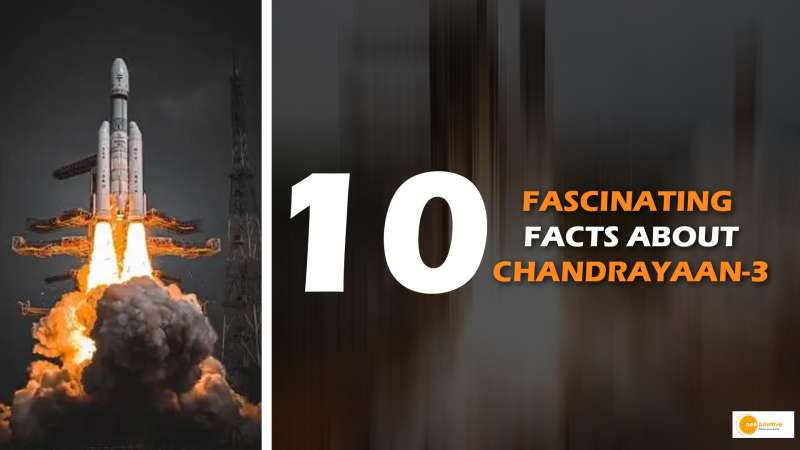


Chandrayaan-3, ISRO’s third lunar exploration mission launched on July 14, 2023, aiming to achieve a soft landing on the Moon’s south pole. With this milestone, India will become the fourth nation to accomplish a successful lunar landing and the first country to land a spacecraft on the Moon’s southern region. Let’s explore ten intriguing facts about Chandrayaan-3, ISRO’s ambitious endeavour.
1. Mission Overview: Chandrayaan-3, also referred to as the LVM3-M4 mission, marks the fourth operational mission of the Launch Vehicle Mark III (LVM3).
2. Mission Objectives: Chandrayaan-3 consists of a lander, a rover, and a propulsion module. Its primary goals include demonstrating soft landing and roving on the lunar surface, conducting in-situ scientific experiments, and developing technologies for future interplanetary missions.
3. Lander Module: The lander module encompasses the rover, and the propulsion module will transport them to a 100-kilometre lunar orbit before separating.
4. Mission Phases: Chandrayaan-3 comprises three phases: Earth-centric, lunar transfer, and Moon-centric phases. These encompass pre-launch preparations, launch and ascent, trajectory selection, lunar orbit insertion, and landing.
5. Spectro-polarimetry Payload: The propulsion module carries a payload called Spectro-polarimetry of HAbitable Planet Earth (SHAPE), which studies Earth’s spectral and polarimetric signatures from lunar orbit. This data aids in analyzing reflected light from exoplanets for potential habitability.
6. Lunar Orbit Parameters: After separation from the launch vehicle, Chandrayaan-3 enters a lunar circular orbit measuring 100 × 100 square kilometres. The propulsion module weighs 2,148 kilograms, generates 758 Watts of power, and operates for three to six months.
7. Lander Payloads: The lander houses several payloads, including Chandra’s Surface Thermophysical Experiment (ChaSTE), Instrument for Lunar Seismic Activity (ILSA), Laser Retroreflector Array (LRA) Rover, and Radio Anatomy of Moon Bound Hypersensitive ionosphere and Atmosphere (RAMBHA). These payloads study thermal properties, seismic activity, and the lunar atmosphere.
8. Rover Payloads: The rover carries two payloads, the Alpha Particle X-ray Spectrometer (APXS) and the Laser-Induced Breakdown Spectroscope (LIBS). APXS analyzes elemental composition, while LIBS examines the chemical and mineralogical properties of the lunar surface.
9. Launch Vehicle Specifications: The LVM3-M4, standing at a height of 43.5 meters and weighing 642 tonnes, features two strap-on motors, a payload fairing, and two stages: L110 (liquid fuel) and C25 (cryogenic fuel). The strap-on motors are solid rocket boosters.
10. Soft Landing Parameters: The lander’s touchdown on the lunar surface aims for a horizontal velocity below 0.5 meters per second, vertical velocity below two meters per second, and a slope of less than 120 degrees.
Conclusion
Chandrayaan-3 represents a significant milestone for India’s space exploration. Through its advanced payloads, precise landing objectives, and exploration capabilities, this mission propels India’s efforts to expand scientific knowledge and pave the way for future interplanetary missions.
Also Read: Chandrayaan-3: जानें कौन हैं भारत की रॉकेट वुमन, चंद्रयान-3 में निभा रहीं हैं महत्वपूर्ण भूमिका!

