

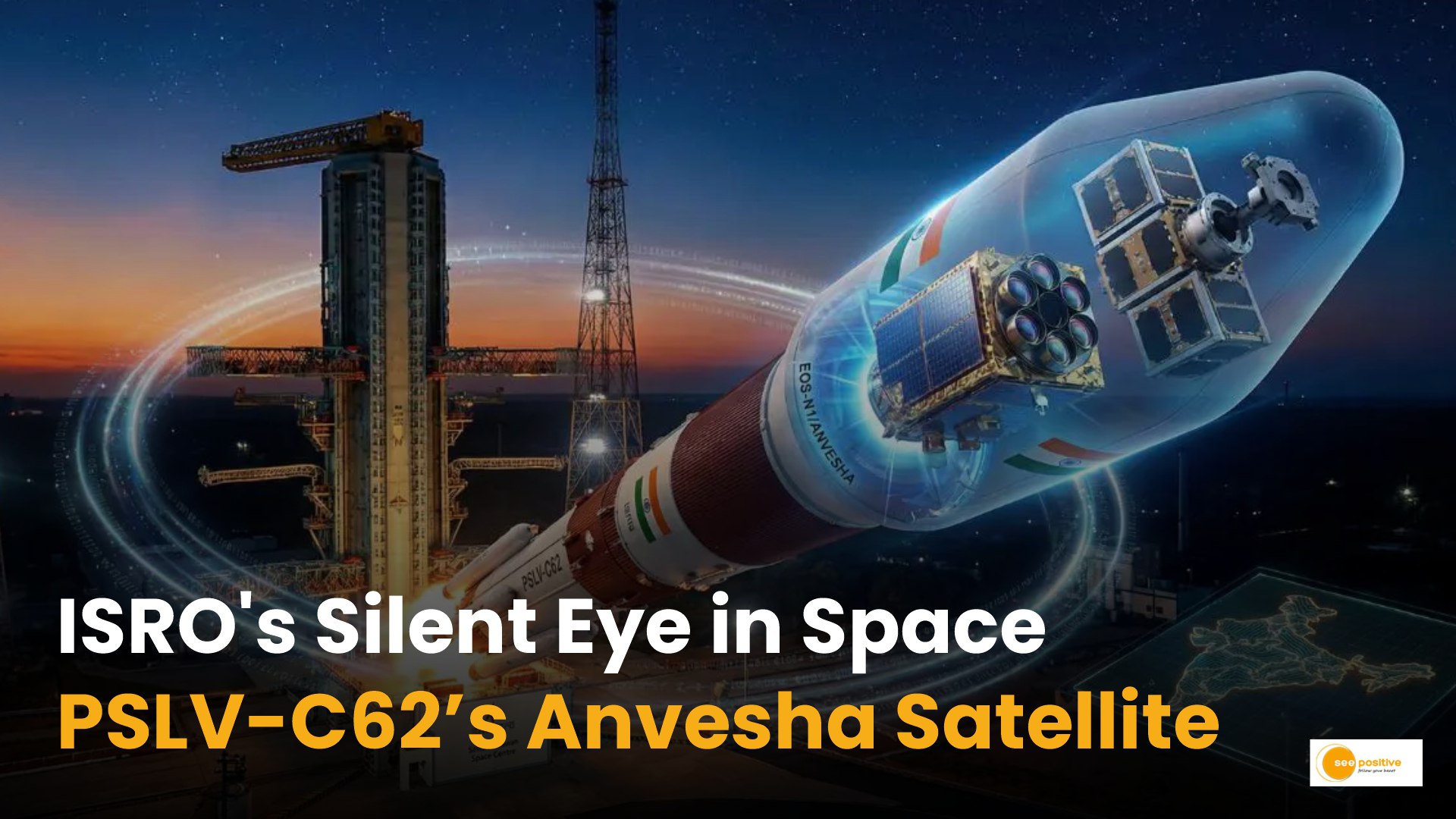
ISRO PSLV-C62 Lift Off, Anvesha
In a significant milestone for India’s space programme, the Indian Space Research Organisation (ISRO) has successfully launched PSLV-C62, marking the nation’s first orbital mission of 2026. The Polar Satellite Launch Vehicle lifted off from the Satish Dhawan Space Centre in Sriharikota on 12th Jan. The star payload of PSLV-C62 is Anvesha. It is carrying a suite of satellites that highlight India’s growing capabilities in Earth observation, defence, and commercial space technology.
PSLV-C62 Lift Off – Mission Overview
The PSLV-C62 mission — the 64th flight of ISRO’s trusted workhorse launcher — marked a strong return to flight after last year’s setback. With its four stages successfully igniting and performing as planned, the rocket placed its payloads into a Sun-Synchronous Orbit, beginning India’s ambitious space calendar for the new year.
Primary Satellite: Anvesha (EOS-N1)
ISRO PSLV-C62 Lift Off, Anvesha
The star payload of PSLV-C62 is Anvesha, officially designated as EOS-N1, a state-of-the-art Earth observation satellite developed by the Defence Research and Development Organisation (DRDO) in collaboration with ISRO’s scientific ecosystem.
What Makes Anvesha Special
- Type: Hyperspectral Earth Observation Satellite
- Purpose: Strategic surveillance, resource monitoring, and environmental data
- Capabilities:
- Hyperspectral imaging captures Earth’s surface across hundreds of narrow spectral bands, enabling advanced material identification and terrain analysis — far beyond standard optical imagers.
- Critical for border security, agriculture assessment, disaster response, and natural resource mapping.
- Provides actionable data back to defence and civil agencies to track changes on the ground in near-real time.
Anvesha’s advanced imaging suite strengthens India’s remote-sensing portfolio and positions it among the world’s most capable small-satellite observation platforms.
Co-Passenger Satellites
ISRO PSLV-C62 Lift Off, Anvesha
Alongside Anvesha, PSLV-C62 carried 15 co-passenger satellites from a mix of domestic startups, academic institutions, and international partners. These include:
- Technology demonstrators focused on emerging space capabilities.
- Startup missions showcasing AI, imaging systems, and advanced sensors.
- Commercial payloads from global customers facilitated via NewSpace India Ltd (NSIL), ISRO’s commercial arm.
This rideshare model underlines India’s expanding role in the global small-satellite launch market.
Return of PSLV After Setback
ISRO PSLV-C62 Lift Off, Anvesha
The PSLV family of rockets has been the backbone of India’s space programme for decades, with iconic missions like Chandrayaan-1, Mars Orbiter Mission, and Aditya-L1. The successful flight of C62 underscores ISRO’s engineering resilience after the partial setback in 2025.
According to official sources, all critical stages functioned normally this time, restoring confidence among stakeholders and international clients.
Strategic and Commercial Impact
ISRO PSLV-C62 Lift Off, Anvesha
The PSLV-C62 success has broad implications:
- Boosts Earth observation data capacity for civil and defence use.
- Strengthens India’s position in the global small-satellite launch ecosystem.
- Encourages private space innovation through rideshare opportunities.
- Accelerates future missions planned for 2026 and beyond.
Read more on space: https://seepositive.in/innovationtech/space-tourism-space-travel/

