

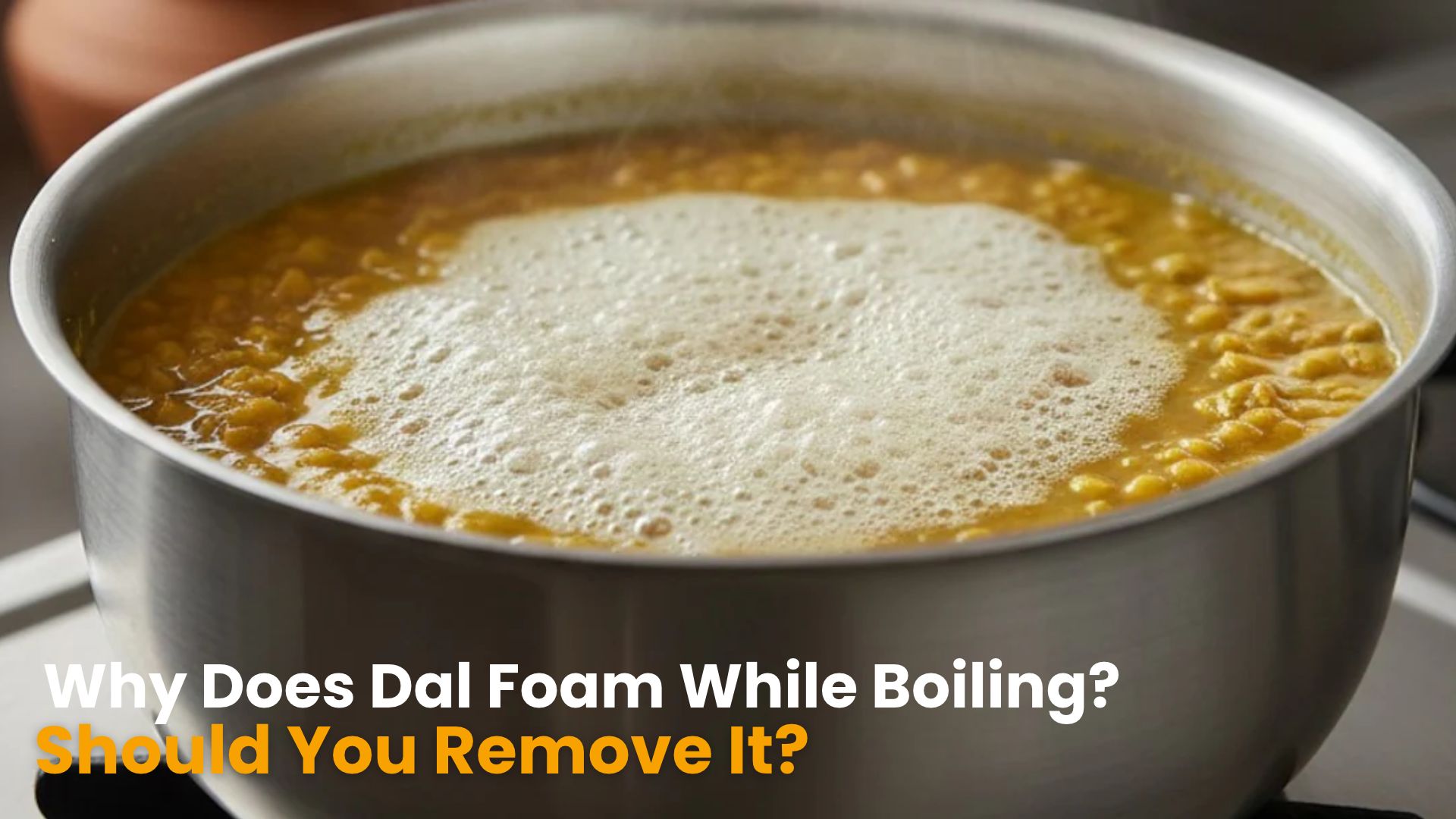
Have you ever noticed a layer of white foam forming on dal while it boils? Many people remove it immediately, assuming it contains dirt or impurities. But is that really necessary? The answer lies in the science of cooking pulses. From proteins and starch to natural plant compounds, several factors contribute to this common kitchen phenomenon. Here’s what the foam actually contains and whether you should remove it.
Dal is a staple in Indian households. Whether it is moong, masoor, toor, chana or urad dal, pulses are cooked almost every day in many kitchens.
However, one thing is common while preparing dal: a white or light-coloured frothy layer appears on the surface during boiling.
Some people skim it off with a spoon, while others allow it to mix back into the dal.
So, why does dal foam while boiling? Is it harmful? Does removing it affect the nutritional value of your meal? Let’s understand.
1. Why Does Dal Foam While Boiling?
The foam that appears while cooking dal is a natural result of its composition.
Pulses contain proteins, starch and other naturally occurring compounds. When dal is soaked and heated in water, some of these substances are released into the cooking liquid.
As the water boils, steam bubbles rise to the surface. Proteins and other compounds can help stabilise the bubbles, creating a frothy layer.
This is why foam commonly appears when cooking different types of lentils and beans.
The amount of foam can vary depending on the type of dal, its age, soaking time and cooking method.
2. Protein Is One of the Main Reasons
Dal is known for its plant-based protein content.
When pulses are heated in water, some soluble proteins and other nitrogen-containing compounds enter the cooking liquid.
These proteins can help stabilise air bubbles formed during boiling.
As a result, the bubbles stay on the surface longer and create foam.
This is a normal part of cooking pulses and does not automatically indicate that the dal is contaminated or spoiled.
3. Starch Also Contributes to the Foam
Another reason behind dal foam is starch.
Pulses contain carbohydrates, including starch. During cooking, some starch is released into the surrounding water.
This can increase the thickness of the cooking liquid and contribute to the frothy appearance.
The combination of starch, proteins and other naturally occurring compounds influences how much foam develops.
4. What Are Saponins in Dal?
Saponins are naturally occurring plant compounds found in several legumes, including certain types of pulses.
They are known for their ability to produce foam when mixed with water.
This property is called foaming activity.
Saponins have a chemical structure that allows them to interact with water and air, helping bubbles form and remain stable.
Their concentration varies across different plant varieties.
This is another reason why some dals produce more foam than others.
5. Is the White Foam on Dal Harmful?
The good news is that the foam produced during normal dal cooking is generally harmless.
It is not necessarily dirt, poison or a sign of contamination.
The foam mainly contains naturally released proteins, starch and plant compounds such as saponins.
Saponins are found in several legumes and are responsible for their characteristic foaming properties. Their levels vary depending on the type of pulse.
The presence of foam does not mean that the dal is unhealthy or unsafe to eat.
6. Should You Remove Foam While Cooking Dal?
Removing the foam is optional.
There is no general food-safety requirement to skim it off during normal cooking.
However, removing it can be useful for a few reasons:
- It gives the dal a clearer appearance.
- It can help prevent the pot from overflowing.
- It may reduce some surface compounds and bitter notes.
- It can make the finished cooking liquid look smoother.
If you prefer to retain the cooking liquid and its contents, you can simply allow the foam to settle back into the dal.
Both methods are acceptable.
7. Does Removing Dal Foam Reduce Its Nutritional Value?
This is another common question.
Some people worry that skimming the foam means throwing away the protein present in dal.
The foam can contain small amounts of soluble proteins and other food components. However, removing the surface foam does not mean that all the protein is lost.
Most of the protein remains in the cooked pulses.
Therefore, skimming a little foam is unlikely to make a major difference to the overall nutritional value of your meal.
However, discarding large amounts of cooking liquid can remove some water-soluble nutrients and food components.
8. Does Dal Foam Cause Gas and Bloating?
Many people associate the foam on dal with digestive problems.
However, visible foam is not a reliable indicator of whether dal will cause gas.
Bloating after eating pulses is commonly associated with fermentable carbohydrates called oligosaccharides. These carbohydrates are not completely digested in the small intestine.
Instead, gut bacteria ferment them in the large intestine, producing gas.
The amount of discomfort varies from person to person and depends on factors such as portion size, digestive sensitivity and preparation methods.
Simply removing the foam is not a proven way to prevent bloating.
9. Does Soaking Dal Reduce Foam?
Yes, soaking can change how dal behaves during cooking.
When pulses are soaked in water, some water-soluble compounds move into the soaking liquid.
This can reduce certain soluble substances and may also reduce cooking time.
For better results:
- Wash dal thoroughly before soaking.
- Soak suitable varieties for the recommended time.
- Discard the soaking water if you want to remove some leached compounds.
- Rinse once more before cooking.
- Cook until the dal becomes completely soft.

