

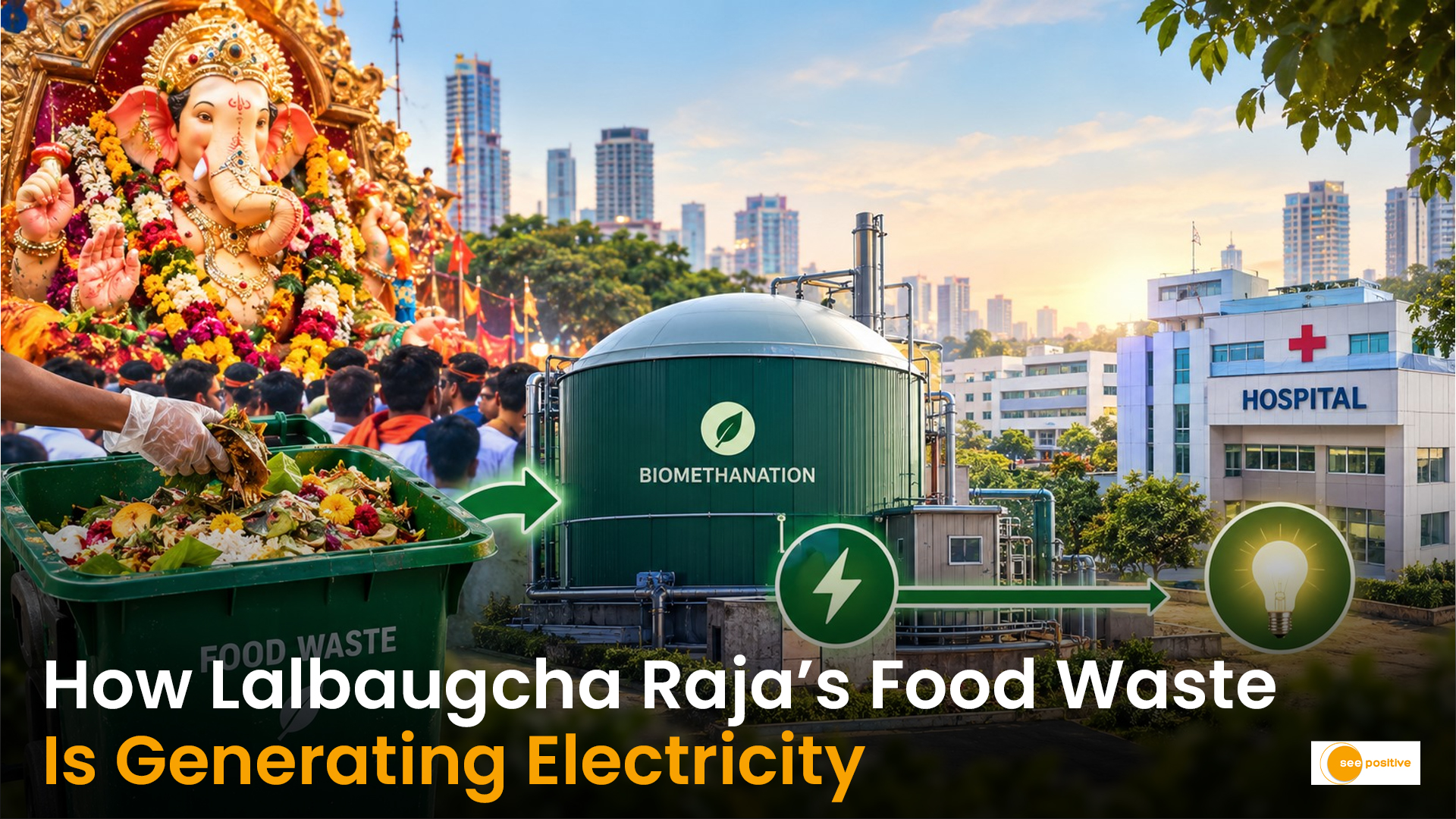
Mumbai’s iconic Lalbaugcha Raja festival has found an innovative way to turn food waste into renewable energy. Under the “Prasad to Power” initiative, leftover food from the festival was collected and processed to generate biogas and electricity for a civic hospital.
The initiative was undertaken by the Brihanmumbai Municipal Corporation (BMC) in collaboration with the Lalbaugcha Raja Sarvajanik Ganeshotsav Mandal.
Nearly 39 Tonnes of Food Waste Collected
During the 12-day Ganesh festival, around 39 tonnes of leftover food generated from prasad distribution and community meals were collected separately.
The wet waste was transported for processing instead of being sent directly to conventional waste-disposal facilities. According to civic officials, 45 trips were made to transport the collected organic waste.
The initiative focused on segregating food waste at source so that it could be processed through biomethanation.
Food Waste Converted Into Biogas
The collected organic waste was processed at a biomethanation plant at Sewri TB Hospital.
Through the biomethanation process, microorganisms break down organic matter in the absence of oxygen. This produces biogas, which can be used as a renewable source of energy.
The food waste collected during the festival generated approximately 3,645 cubic metres of biogas and 4,382 kWh of electricity.
The electricity generated was supplied to Ward 9 of Sewri TB Hospital, which has around 90 patients.
What Is Biomethanation?
Biomethanation is a biological process used to treat biodegradable waste.
During the process, organic material such as food waste is broken down by microorganisms in an oxygen-free environment. The process produces biogas, which can be used for energy generation.
It also produces a residual material that can be further treated and used as a resource, depending on its quality and the treatment process.
Sewri Plant Has a Daily Capacity of Two Tonnes
The biomethanation plant at Sewri TB Hospital can process approximately two tonnes of organic waste per day.
Since the festival generated more waste than the facility could process within its daily capacity, some of the collected waste was sent to other civic biomethanation facilities.
These included plants located at Sion, Kasturba and Nair hospitals.
Turning Festival Waste Into Useful Energy
Religious and cultural festivals can generate large quantities of food and other organic waste. Traditionally, much of this waste may end up being transported to waste-processing or disposal facilities.
The Prasad to Power initiative provides an alternative approach by treating segregated food waste as a potential source of renewable energy.
Instead of simply disposing of leftover food, the waste can be processed to produce biogas and electricity.
A Step Towards Sustainable Waste Management
The initiative brings together festival management, waste segregation, renewable energy and civic infrastructure.
For Mumbai, where managing large volumes of municipal waste is a continuing challenge, converting biodegradable waste into energy can help create a more resource-efficient waste-management system.
The Lalbaugcha Raja initiative demonstrates a simple principle: food waste can become a resource when it is properly segregated, collected and processed.
By converting leftover prasad and food waste into energy for a hospital, the project gives discarded food a second life while supporting cleaner and more sustainable waste management in the city.

