

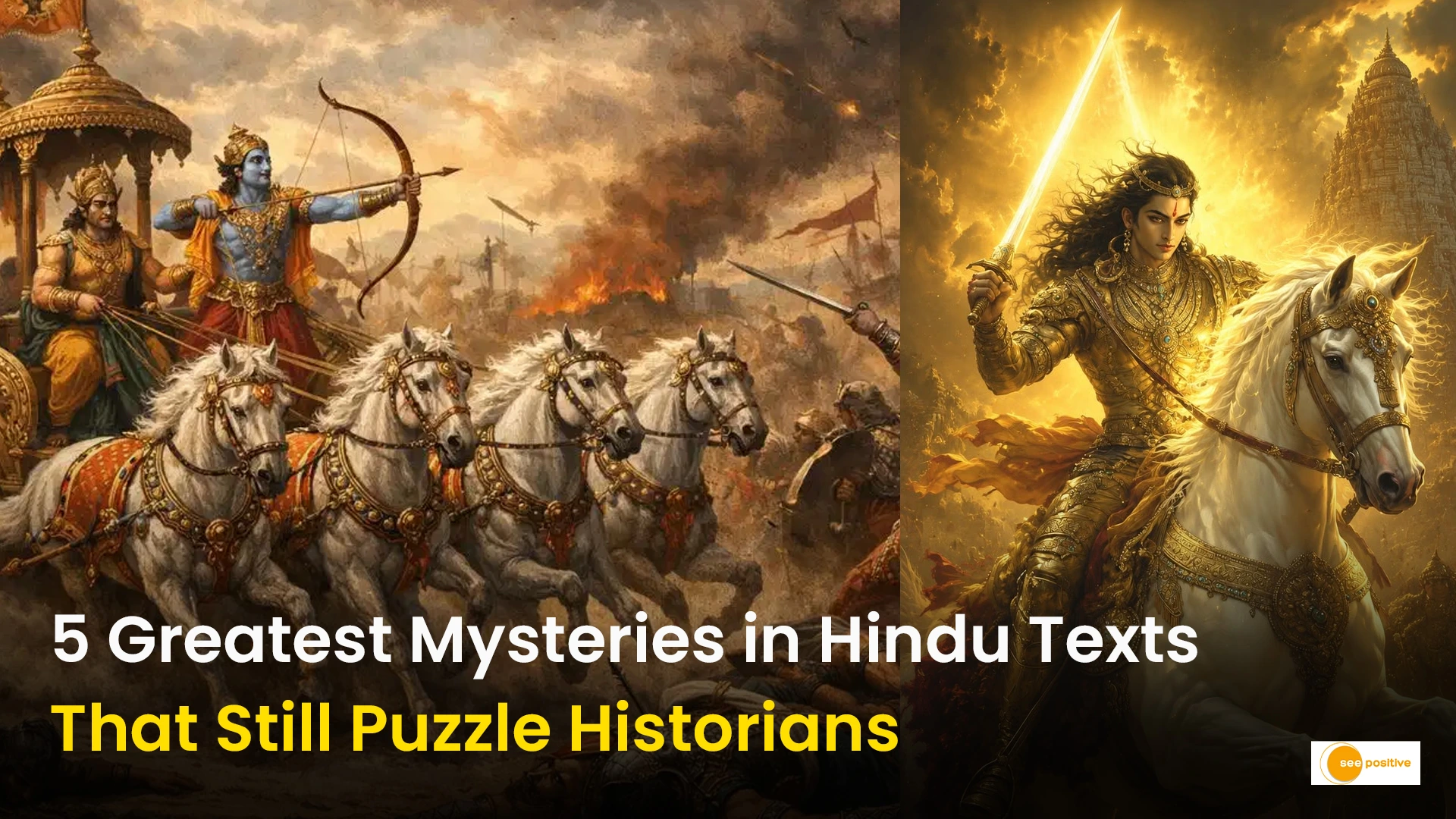
For thousands of years, Hindu scriptures such as the Mahabharata, Ramayana, Vedas, and Puranas have inspired philosophers, historians, archaeologists, and spiritual seekers alike. While many events described in these texts are matters of faith, some have also sparked scientific investigations and archaeological research.
Interestingly, several mysteries mentioned in these ancient scriptures continue to fuel debate even today. Some have partial historical evidence, while others remain firmly in the realm of mythology and belief.
Here are five of the most fascinating mysteries associated with Hindu scriptures.
1. Was Lord Krishna’s Dwarka a Real City?
Among the greatest mysteries in Hindu tradition is the legendary city of Dwarka, described in the Mahabharata and the Bhagavata Purana as the magnificent kingdom of Lord Krishna.
According to the scriptures, Dwarka was eventually submerged beneath the sea after Krishna’s departure from Earth.
Marine archaeological expeditions off the coast of modern-day Dwarka in Gujarat have discovered submerged structures, stone anchors, and evidence of ancient maritime activity. These findings confirm that ancient settlements existed in the region. However, archaeologists have not conclusively established that the underwater remains are the same Dwarka described in the Mahabharata.
This makes Dwarka one of the rare places where mythology, archaeology, and history intersect—without providing a definitive answer.
2. What Happened to the Saraswati River?
The Rig Veda repeatedly describes the Saraswati as a mighty river flowing between the Yamuna and Sutlej.
Today, no such major river exists.
Over the past few decades, satellite imagery, geological surveys, and sediment analysis have identified ancient dried river channels across northwestern India and Pakistan. Many researchers believe these channels may represent parts of the long-lost Saraswati river system, although debate continues over its exact course and timeline.
While geology suggests that climate change and tectonic shifts likely altered river systems over thousands of years, the precise identity of the Vedic Saraswati remains an active area of research.
3. The Enigma of the Vimanas
Ancient Sanskrit literature occasionally mentions Vimanas—flying vehicles associated with gods and celestial beings.
Descriptions appear in several later texts and epics, leading some modern writers to speculate about ancient aviation technology.
However, historians caution against interpreting these passages literally. Most scholars view Vimanas as mythological or symbolic elements rather than evidence of advanced prehistoric aircraft. Furthermore, there is no archaeological evidence proving that such machines existed.
The mystery lies not in whether airplanes existed in ancient India, but in understanding the literary and symbolic meanings behind these extraordinary descriptions.
4. The Immortals of Hindu Tradition
Hindu tradition speaks of the Chiranjivis—beings believed to remain alive across ages for a divine purpose.
Among those traditionally listed are:
- Hanuman
- Ashwatthama
- Vibhishana
- Kripacharya
- Parashurama
- Vyasa
- King Mahabali
- Markandeya (included in some traditions)
Many local legends claim sightings or encounters with some of these figures, particularly Ashwatthama in central India.
Despite countless stories, none of these claims have ever been independently verified. Their enduring presence reflects religious belief rather than historical documentation, making the Chiranjivis one of Hinduism’s most enduring spiritual mysteries.
5. The Cosmic Timeline of the Yugas
Hindu scriptures describe time on an extraordinary scale through the concept of the four Yugas:
- Satya Yuga
- Treta Yuga
- Dvapara Yuga
- Kali Yuga
Together they form a Mahayuga lasting 4.32 million years, according to traditional Hindu cosmology.
Modern geology and cosmology measure Earth’s history using completely different scientific methods, leading scholars to interpret these enormous numbers in different ways. Some see them as symbolic representations of cosmic cycles, while others accept them literally as sacred chronology.
The true intention behind these immense timelines continues to be debated among theologians, historians, and philosophers.
Why These Mysteries Continue to Fascinate
Unlike many ancient civilizations whose stories faded over time, Hindu scriptures remain living traditions practiced by millions today. As archaeology uncovers new discoveries and scientific techniques become more advanced, some questions gain fresh evidence while others become even more intriguing.
It is important to distinguish between faith-based beliefs, historical inquiry, and scientific evidence. In many cases, these perspectives complement one another; in others, they lead to different conclusions.
Perhaps that is why these ancient mysteries continue to capture global curiosity—not because they all have answers, but because they encourage exploration across history, philosophy, archaeology, and spirituality.
Humanity’s oldest questions remain as compelling
From the submerged city of Dwarka to the vanished Saraswati River, from the legendary Vimanas to the timeless Chiranjivis, Hindu scriptures contain narratives that continue to inspire investigation and wonder.
Whether viewed through the lens of faith or scholarship, these mysteries remind us that some of humanity’s oldest questions remain as compelling today as they were thousands of years ago.
You may also like: Know some fascinating facts about The International Space Station

